Key takeaways
- Six categories cover most of the market: wellness, beauty, personal care, home care, durables and agri inputs.
- Consumables are re-ordered. Durables are bought once.
- Each category has its own regulator and label rules. Check them first.
What are the main categories of direct selling products?
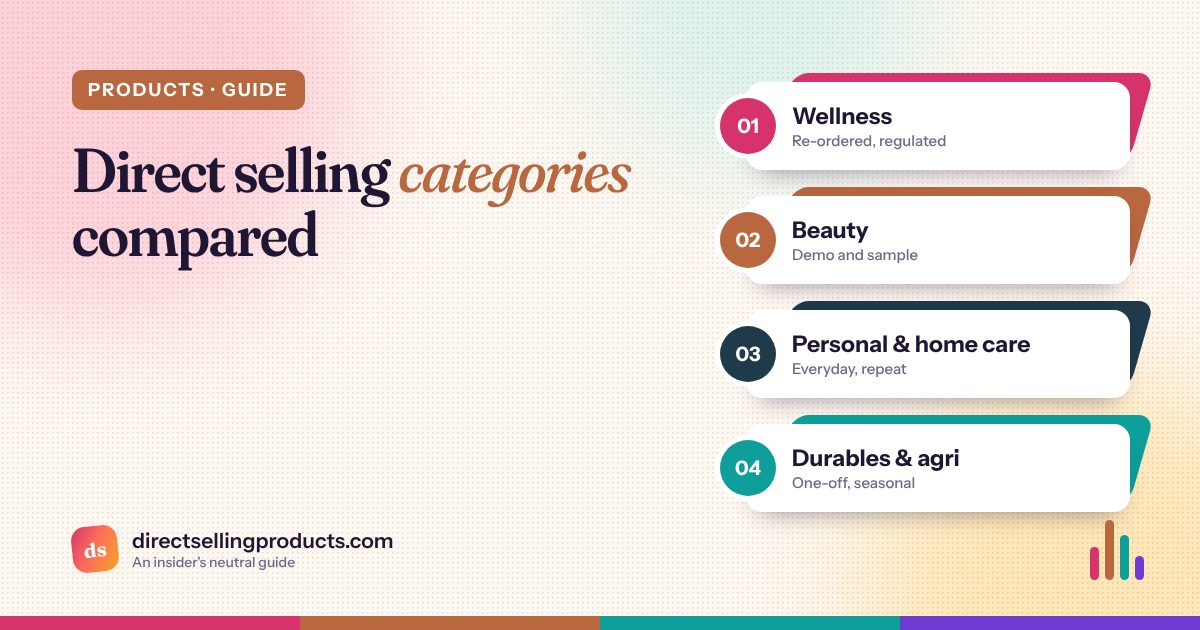
The main categories of direct selling products are wellness and nutrition, skincare and beauty, personal care, home care and cleaning, durables such as cookware or water purifiers, and agricultural inputs. Consumable categories are bought repeatedly, while durables are bought once, which changes how selling works.
The six categories compared
| Category | Buying pattern | How it's sold | Check first |
|---|---|---|---|
| Wellness and nutrition | Monthly re-order if used daily | Conversation, trust, follow-up | Food-safety licence, realistic claims, the label |
| Skincare and beauty | Re-order every 1-3 months | Demo, samples, before-and-after caution | Ingredients, patch test, shelf life |
| Personal care | Frequent, low-ticket | Bundles, subscriptions | Price per use, climate fit |
| Home care | Frequent, concentrates last long | Live demos | Cost per use, safety directions |
| Durables | Once, then service | Home demo, finance, referrals | Warranty, service network, returns |
| Agri inputs | Seasonal | Field visits, trials | Product registration, seasonal fit |
Consumables vs durables
The line that matters most is not the product type but whether it runs out.
- Consumables (supplements, skincare, cleaners, personal care) build repeat customers and steady income. They also depend on honest customer service, because trust decides the re-order.
- Durables (cookware, appliances, purifiers) pay larger one-time margins but need constant new buyers, plus warranty and service you can rely on.
A business that depends on constantly finding new buyers for durables works very differently from one that serves a stable group of repeat customers. Ask which one you're joining. Product vs opportunity →
Rules that differ by category
- Food and supplements: a food-safety regulator governs licences, labels and claims. In India that's FSSAI; in the USA, the FDA. Label guide →
- Cosmetics: separate cosmetics rules cover labelling, ingredients and manufacturing. In India, the Drugs and Cosmetics framework and CDSCO; in the USA, the FDA.
- Household chemicals: safety warnings and storage directions matter.
- Farm inputs: fertilisers and pesticides are separately regulated, and in India need state-level approvals.
To judge any product from these categories on the same terms, use the 10-check guide. For definitions of the basics, see What are direct selling products?
Frequently asked questions
Which direct selling product category is the biggest?
Globally, wellness and personal care or beauty are consistently the largest categories, with household and home care behind them. Rankings change by country and year, so check current figures from industry bodies such as the World Federation of Direct Selling Associations.
Which category is easiest to start with?
Everyday consumables you would use yourself, such as personal care, home care or a daily supplement, because customers re-order them and you can speak from experience. Higher-priced durables take longer to sell.
Do all categories have the same legal rules?
No. Food and supplements, cosmetics, household chemicals and farm inputs each have their own regulators and labelling rules, and these differ by country.
Sources
- Food Safety and Standards Authority of India. www.fssai.gov.in
- U.S. FDA: Dietary supplements. www.fda.gov
- CDSCO, India (cosmetics and drugs regulator). cdsco.gov.in
- World Federation of Direct Selling Associations. wfdsa.org