Key takeaways
- The test is where the money comes from: real customers, or new recruits.
- A product existing does not make a scheme legal. Regulators follow the money, not the merchandise.
- MLM is legal. It becomes a pyramid when pay depends mainly on recruiting or on members' own qualifying purchases.
- You can run five checks yourself, in order, before paying anything.
What is the difference between direct selling and a pyramid scheme?
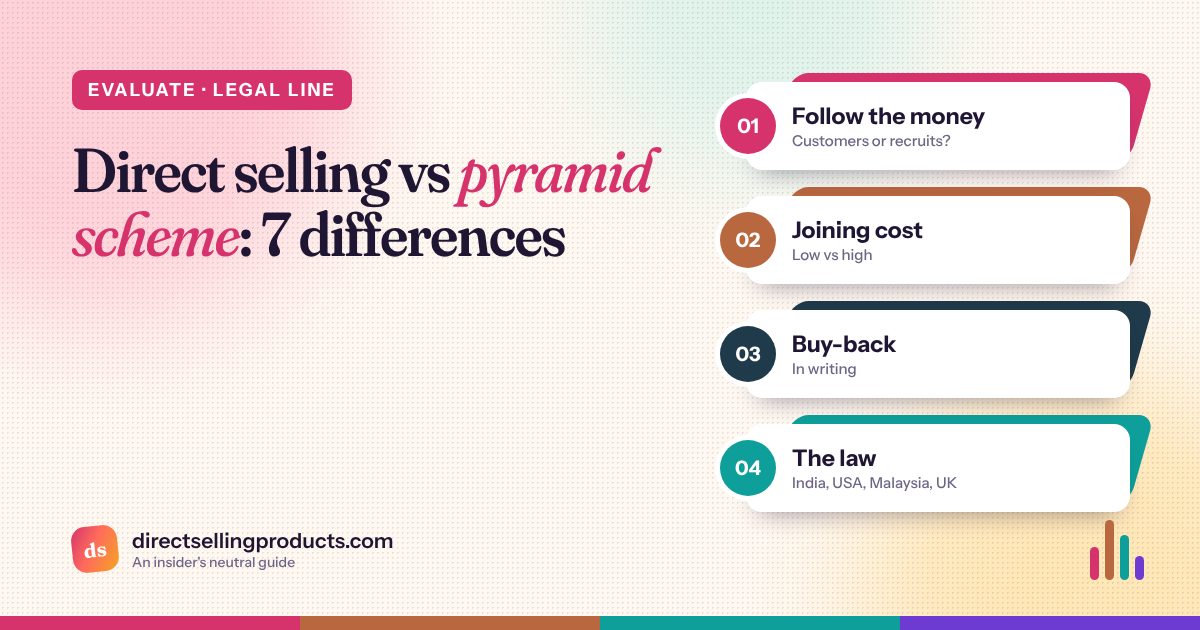
The difference between direct selling and a pyramid scheme is where the money comes from. In direct selling, income comes mainly from selling real products to customers. In a pyramid scheme, income comes mainly from recruiting new participants and their payments, and the product is secondary or incidental.
That single question explains almost every legal ruling on the subject. The rest of this guide shows how it plays out in practice: a side-by-side table, five tests you can run yourself, and how four countries draw the line.
Direct selling vs pyramid scheme: side by side
| Question | Legitimate direct selling | Pyramid scheme |
|---|---|---|
| 1. Main source of income | Product sales to customers | Joining payments and recruitment |
| 2. Joining cost | Low or none; kit optional | High, often non-refundable |
| 3. Who buys the products | Mostly people outside the network | Mostly members, to "qualify" |
| 4. What the pitch stresses | Product, customers, service | Ranks, lifestyle, "get in early" |
| 5. Unsold stock | Written buy-back policy | Your problem |
| 6. Pay structure | Retail margin plus commission on real sales | Rewards for each person recruited |
| 7. Without new recruits | Survives on retail sales | Collapses |
The three-question test, as a flowchart
A simplified version of how regulators reason. Not legal advice.
Five tests you can run before you pay anything
Do them in this order. The early ones take minutes and rule out most bad options.
1. Ask who buys the products
Ask your would-be sponsor: "What share of the company's sales go to customers who are not members?" A good company can answer, or at least point to a published figure. If every example you're given is a member buying more stock, that's the pattern regulators look for.
2. Check what the joining cost buys
Joining should cost little, and what you pay should be products you'd use or can resell. Be cautious when you must pay a fee for the "right" to recruit, or when the main thing you receive for a large payment is a position in the structure. In India, the 2021 rules say direct sellers shouldn't be required to pay an entry or registration fee.
3. Test whether pay needs recruiting
Ask: "If I never recruit anyone and only sell to customers, what can I earn?" Then ask the harder one: "Which rank bonuses require me to build a team?" Commissions on a team's genuine retail sales are normal in MLM. Rewards paid mainly for each new person signed up, or for sign-ups that never sell to anyone outside the network, are the classic pyramid feature.
4. Get the buy-back policy in writing
A legitimate company will take back unsold, saleable products for a refund within a set period and give you a cooling-off window. Ask for it as a link or PDF from the company, not as a promise from a team leader. If the policy doesn't exist, or exists only in a leader's WhatsApp message, treat that as a no.
5. Read the income disclosure
The income disclosure statement shows what participants actually earned. Look at the median, the share who earned nothing, and whether the figures are before or after costs. If the company doesn't publish one, every income claim you hear is unverified. The full 9-check method →
Where MLM fits, and why "legal" isn't the same as "likely to earn"
Multi-level marketing is a way of paying direct sellers: a retail margin on what you sell, plus commission on the sales of people you sponsor. It is lawful in the countries covered here when the money comes mainly from product sales to real customers.
Two things are worth keeping separate:
- Lawful means the structure passes the legal test.
- Worth joining is a different question. A lawful MLM can still cost you money if you buy more stock than you can sell or keep spending to hold a rank. The company's own income disclosure is the best evidence you'll get.
A plan can also drift. A company with real products and a lawful plan on paper can still behave like a pyramid if most purchases are made by members to hit targets. That's why the tests above ask what actually happens, not what the brochure says.
How the law draws the line in four countries
Banned under two laws
The Consumer Protection (Direct Selling) Rules, 2021 prohibit pyramid schemes and require direct selling entities to have a registered office and a grievance mechanism. Older law, the Prize Chits and Money Circulation Schemes (Banning) Act, 1978, targets schemes that pay mainly for enrolling members. India guide →
The FTC follows the money
There's no federal licence for direct sellers. The FTC's long-standing approach asks whether rewards for recruiting are unrelated to sales to real consumers. In a 1979 decision on Amway, it found the plan lawful in part because of safeguards such as a buy-back rule and retail-sale requirements. In 2014 a federal appeals court held that BurnLounge was a pyramid, noting that most purchases were made by participants themselves. USA guide →
Licensing and an anti-pyramid act
The Direct Sales and Anti-Pyramid Scheme Act 1993 regulates direct sales businesses and prohibits pyramid schemes. Companies need a licence from the trade authorities, so checking licence status is an extra step available here.
A banned practice
Pyramid promotional schemes are prohibited under UK consumer protection law, and the enforcement agency for most cases is the Trading Standards service or the CMA. Local rules change, so confirm with the current government guidance.
The founder was formerly with Amway, the company named in the 1979 decision above. We mention the decision only as a public regulatory ruling, as an example of the safeguards regulators look for. See our disclosure.
Pyramid scheme vs Ponzi scheme vs MLM
| Pyramid scheme | Ponzi scheme | MLM | |
|---|---|---|---|
| What is sold | A product or "opportunity"; the real product matters little | An investment promising returns | Real products to customers |
| Where payouts come from | New recruits' payments | New investors' money | Customer sales (if lawful) |
| Why it collapses | Recruiting runs out | New deposits run out | Doesn't depend on a collapse |
| Legal status | Illegal | Illegal | Legal if the money comes from real sales |
Four mistakes people make when judging a company
- "They have a great product, so it's fine." Product quality is a separate question from structure.
- "It's a big, famous company." Size doesn't tell you where the money comes from, and size alone isn't a legal defence.
- "There's no recruiting quota." Bonuses and ranks can reward recruiting without an explicit quota.
- "They're registered." Registration shows a company exists. It doesn't show that the compensation plan works as described.
If you think you're already in one
- Stop buying more stock. Each extra purchase increases what you could lose.
- Ask for the buy-back policy in writing and request a refund for unsold, saleable products.
- Keep evidence: receipts, messages, recordings of income claims and any slides you were shown.
- Report it. In India, contact the National Consumer Helpline. In the USA, use the FTC's ReportFraud site. In other countries, find your consumer-protection agency.
This is general information, not legal advice. For a large loss, speak to a consumer lawyer in your country.
Frequently asked questions
Is MLM the same as a pyramid scheme?
No. Multi-level marketing is a way of paying direct sellers, including commission on the sales of people they recruited. It is legal when the money comes mainly from real product sales to customers. A pyramid scheme is illegal because the money comes mainly from recruitment. An MLM that is run badly can drift into pyramid territory, which is why the tests above matter.
Is a pyramid scheme always illegal?
Pyramid schemes are illegal in almost every country that regulates the issue, including India, the USA, Malaysia and the UK. The exact legal test and penalties differ by country, so the rules where you live are the ones that count.
Can a company have real products and still be a pyramid scheme?
Yes. Regulators look at where the money comes from, not at whether a product exists. If rewards depend mainly on recruiting or on participants buying stock to qualify, a real product does not make the scheme lawful.
I paid money to join. What should I do first?
Stop buying more stock, ask the company in writing for its buy-back or cooling-off policy, and keep every receipt, message and recording of income claims. Then report to the regulator in your country. India's National Consumer Helpline and the US FTC's ReportFraud site are listed in the sources.
Sources
- Department of Consumer Affairs, India: Consumer Protection (Direct Selling) Rules, 2021. consumeraffairs.nic.in
- National Consumer Helpline, India. consumerhelpline.gov.in
- U.S. FTC: Business Guidance Concerning Multi-Level Marketing. www.ftc.gov
- U.S. FTC Consumer Advice: Multi-Level Marketing Businesses and Pyramid Schemes. consumer.ftc.gov
- U.S. FTC: Report fraud. reportfraud.ftc.gov