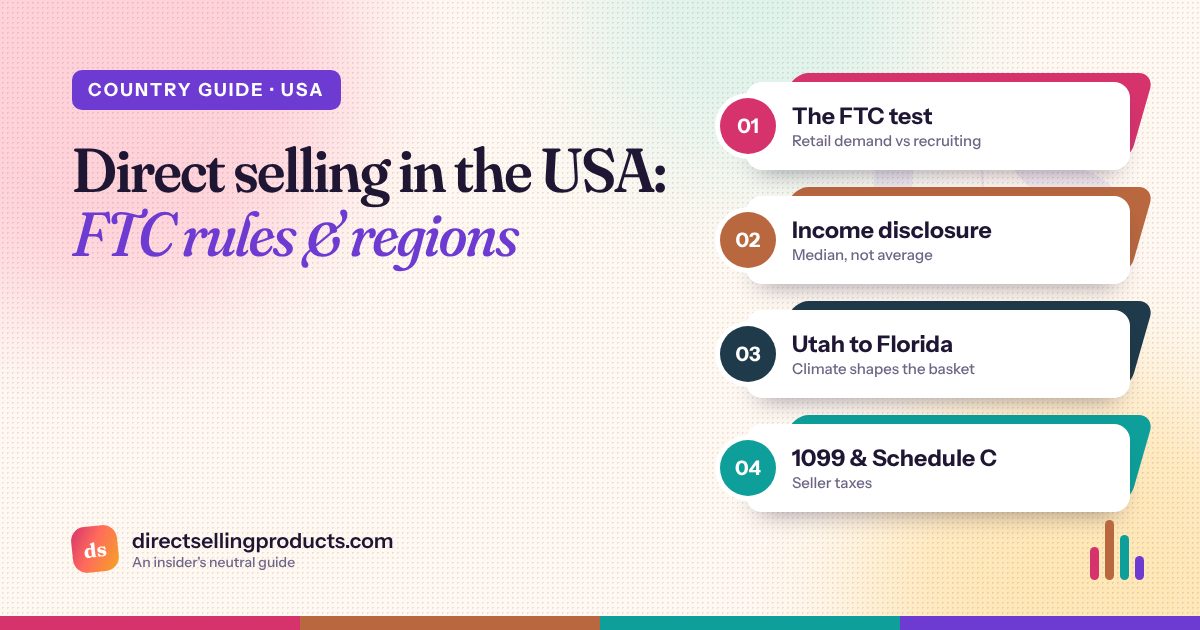
Key takeaways
- MLM is legal in the US when pay comes mainly from real retail demand.
- The FTC test asks whether rewards come from recruiting or from the participants' own qualifying purchases.
- Read the income disclosure statement before joining.
- You're an independent contractor: 1099-NEC, Schedule C and self-employment tax.
Is MLM legal in the United States?
Multi-level marketing is legal in the United States as long as participants are paid mainly for selling products to real customers. The Federal Trade Commission treats a plan as an illegal pyramid scheme when rewards depend mainly on recruiting, or on purchases participants make to qualify, rather than on genuine retail demand.
The FTC test in plain English
- Who's buying? Purchases by people outside the network count as real demand. Purchases made mainly to hit a rank or bonus don't.
- What's rewarded? Pay for recruiting, rather than for sales, points towards a pyramid.
- What's promised? Income and lifestyle claims must reflect what typical participants actually earn.
The FTC question, as a flowchart
A simplified view of how the FTC separates lawful MLM from a pyramid scheme.
State attorneys general enforce too, and the FTC's Business Opportunity Rule can apply to some plans. FTC guidance, explained →
What is an income disclosure statement?
An income disclosure statement is a yearly document from a direct selling company that shows how much participants actually earned, usually by rank. It often shows that a large share earned little or nothing. Reading it before you join is sensible.
| Look for | Why it matters |
|---|---|
| Median, not average | A few top earners inflate the average. |
| Share earning $0 | Often excluded from headline numbers. Find the footnote. |
| Gross vs net | Figures are usually before product purchases, travel and fees. |
| Who's counted | "Active" participants only? That can hide everyone who quit. |
How to read an income disclosure, step by step →
In 2024, FTC staff published a report analysing 70 MLM income disclosure statements, with a consumer alert on what they really tell you.
How direct selling differs across the US
The industry's home base
Provo, Orem, Lehi and Pleasant Grove host the headquarters of several of the largest essential-oil, skincare and wellness companies. Almost everyone knows a seller, so customers are well informed and often sceptical. In the dry high-desert air, lip balm and heavy moisturisers sell all year.
Party-plan heartland
Cosmetics party-plan selling has deep roots around Dallas, and home parties and church-community networks across the suburbs still drive sales. Texas summers push sunscreen, setting sprays and long-wear makeup.
Heat, sun and hydration
Electrolyte drinks, sun care and barrier-repair skincare lead. Many sellers here are retirees, and winter "snowbird" season brings a temporary customer base that leaves in spring.
Humidity rewrites the routine
In Tampa, Miami and Atlanta, lightweight gels, mattifying products and anti-frizz hair care beat rich creams. Hurricane season also affects delivery times, so stock up on regulars before late summer.
A mature market
Ada, just outside Grand Rapids, is the headquarters town of a major direct selling company, one the founder was formerly associated with (see our disclosure). Long-established companies tend to produce a mature local market: long-time customers, multi-generation sellers and a strong focus on household consumables.
New York, LA, Seattle
In dense cities with small apartments, home parties are rare. Selling happens through Instagram, TikTok and Facebook groups. Expect buyers to compare your price with Amazon in seconds.
Taxes for US direct sellers
- You're normally an independent contractor, not an employee.
- Companies issue Form 1099-NEC once your commission passes the IRS reporting threshold. Income is taxable even without one.
- Report on Schedule C and pay self-employment tax. Track samples, mileage and home-office costs.
- Many companies collect state sales tax on your behalf. Check your agreement.
US tax guide for direct sellers →
Frequently asked questions
Do direct sellers pay taxes in the USA?
Yes. Direct sellers are usually independent contractors. Companies issue Form 1099-NEC once commission passes the IRS reporting threshold, and sellers report income and expenses on Schedule C and pay self-employment tax. Income is taxable even if no 1099 is issued.
Is there an industry body in the US?
Yes, the Direct Selling Association (DSA) in Washington, D.C. publishes a code of ethics its member companies agree to follow. Membership is voluntary, so it's a signal, not a guarantee.
Sources
- FTC: Business Guidance Concerning Multi-Level Marketing. ftc.gov
- FTC Consumer Advice: Multi-Level Marketing Businesses and Pyramid Schemes. consumer.ftc.gov
- IRS: Self-Employed Individuals Tax Center. irs.gov