Key takeaways
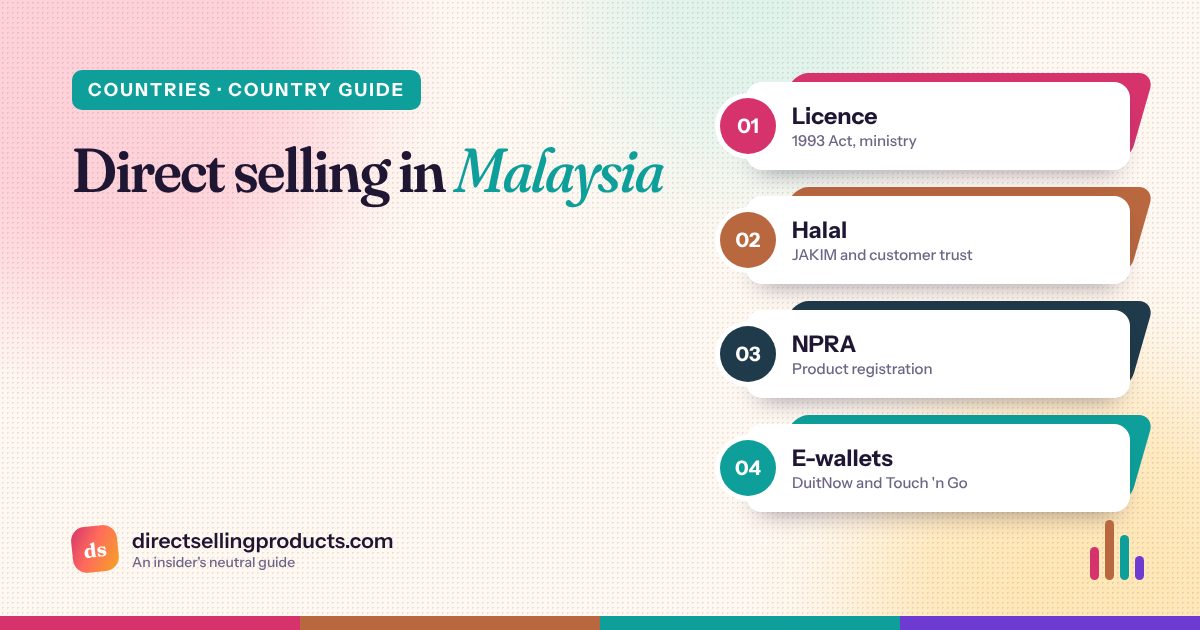
- Direct sales companies are licensed under the 1993 Act. Ask for the licence number.
- Halal matters to a large share of customers. Check the certifying body, not just a logo.
- Supplements and cosmetics are registered with NPRA. Look for the number.
- E-wallets and QR payments are normal. WhatsApp and Facebook carry most selling.
Is direct selling legal in Malaysia?
Yes. Direct selling is legal in Malaysia and is regulated by the Direct Sales and Anti-Pyramid Scheme Act 1993, which requires direct sales businesses to hold a licence from the ministry that administers it and prohibits pyramid schemes. Always ask a company for its licence number and verify it.
This is a general guide, not legal advice. Check current rules with the ministry. For the Act in more detail, see Malaysia's direct selling licence.
Five checks before you join a Malaysian company
| # | Check | Where |
|---|---|---|
| 1 | Direct sales licence number and the licensed company's name | Ministry of Domestic Trade and Cost of Living (KPDN) |
| 2 | Company registration and status | Companies Commission of Malaysia (SSM) |
| 3 | Product registration or notification numbers on labels | NPRA |
| 4 | Halal certification, where claimed | JAKIM or a recognised certifier; check the certificate |
| 5 | Written refund and cooling-off terms | Your contract; see buy-back guide |
How selling differs across Malaysia
Kuala Lumpur, Petaling Jaya, Subang
Dense, connected and price-aware. Condo living and office workers favour delivery and WhatsApp orders over home visits. Afternoon thunderstorms are routine, so lightweight, quick-absorbing skincare and sunscreen sell steadily, and deliveries can slip when roads flood.
George Town and Bayan Lepas
A manufacturing and tourism hub where shift workers and a strong Hokkien-speaking community shape the rhythm. Food and wellness products are discussed in detail, and word of mouth from a trusted neighbour counts for a lot.
The Singapore commuter belt
Many residents work across the Causeway or serve those who do. Price comparison with Singapore is constant, so cost per use and clear invoices matter. Check cross-border rules before shipping anything outside Malaysia.
Kuching and Kota Kinabalu
Longer delivery times, and customers who value a seller they can meet. Rural longhouse and kampung communities buy through trusted contacts and festival gatherings. Wet-season rain can delay shipments.
How Malaysians buy
- Festival calendar. Hari Raya Aidilfitri, Chinese New Year, Deepavali and Christmas drive gifting and personal-care sets, and each audience has its own preferences.
- Several languages. Bahasa Malaysia, English, Mandarin and Tamil are all in everyday use. Serve people in the one they choose.
- Digital payments. Bank transfer via QR, e-wallets such as Touch 'n Go and card payments are common. Cash is still used at meetings.
- Monsoon season. The northeast monsoon from roughly November to March brings heavy rain and floods, especially on the east coast, which affects deliveries and demand.
Tax and records
Commission and retail profit are income. Keep invoices and bank records, and check with the Inland Revenue Board (LHDN) or a tax professional about registration, returns and any sales and service tax that may apply to your activity. Rules and thresholds change.
Selling well in Malaysia
- Lead with the licence and the halal status, if relevant, then the product.
- Match the product to the climate. Humid-weather guide →
- Use the same neutral checks as anywhere: red flags and the income disclosure.
- Keep claims modest. Health and income claims attract scrutiny.
Frequently asked questions
Is direct selling legal in Malaysia?
Yes. It is regulated by the Direct Sales and Anti-Pyramid Scheme Act 1993, which requires direct sales businesses to be licensed and prohibits pyramid schemes. Check the licence with the ministry that administers the Act.
Do direct selling products need to be halal in Malaysia?
Halal certification is not required for every product, but many Muslim customers will only buy foods, supplements and some personal care products that carry recognised halal certification, so it strongly affects what sells. Check the logo and the certifying body.
How do I check a Malaysian product's registration?
Look for the registration or notification number on the label and check it with the National Pharmaceutical Regulatory Agency (NPRA) for supplements, traditional products and cosmetics. Rules and number formats change, so confirm with NPRA.
Sources
- Ministry of Domestic Trade and Cost of Living, Malaysia. www.kpdn.gov.my
- Companies Commission of Malaysia (SSM). www.ssm.com.my
- JAKIM, Malaysia: halal certification. www.halal.gov.my
- National Pharmaceutical Regulatory Agency, Malaysia. www.npra.gov.my
- Inland Revenue Board of Malaysia (LHDN). www.hasil.gov.my