Key takeaways
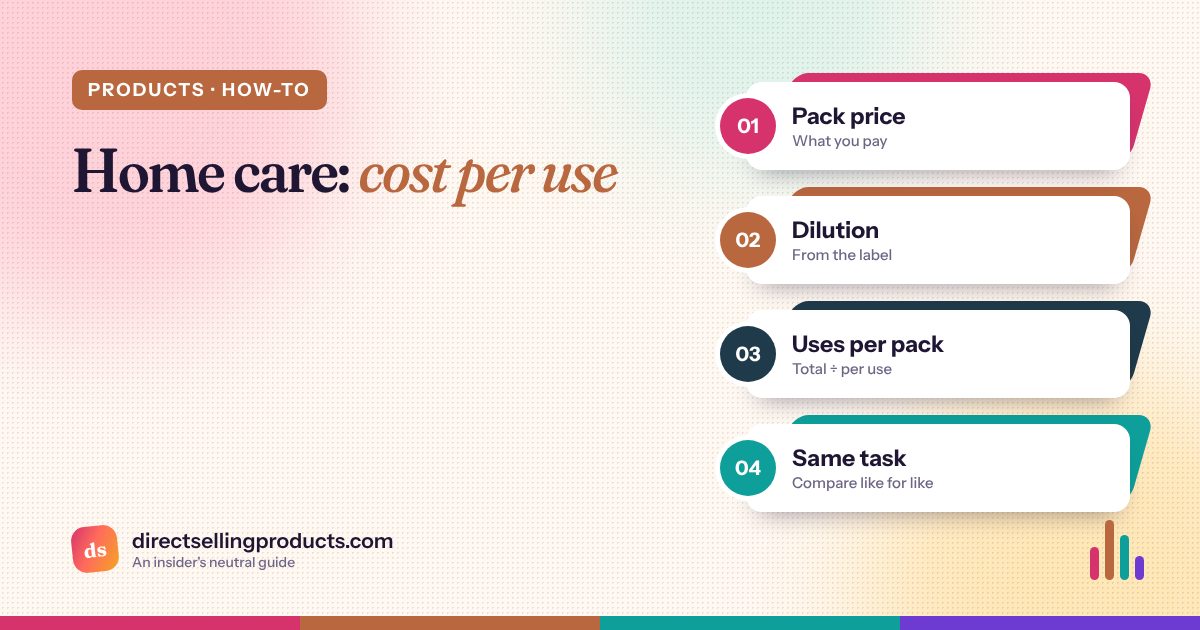
- Divide the pack price by the number of uses. That's cost per use.
- Use the label's dilution for the same task on both products.
- Test the result too. Cheap per use only wins if it cleans as well.
How do you work out cost per use for a cleaning product?
To work out cost per use, divide the pack volume by the amount used per task to get the number of uses, then divide the pack price by that number. Use the dilution printed on the label for the same task on both products, and compare the cleaning result as well as the cost.
1. Find the amount used per task
From the label, find the amount for the task: for example "10 ml in a litre of water for floors" or "5 ml per sink of dishes". Use the value for your real use, not the strongest or weakest.
2. Work out uses per pack
Pack size ÷ amount per use. A 500 ml concentrate used at 5 ml per sink gives 100 uses.
3. Divide the price
Pack price ÷ uses per pack = cost per use.
4. Repeat for the shop product
Do the same for the shop brand, using its label for the same task.
A worked example
Invented numbers, for the task "washing a sink of dishes":
| Product | Pack | Price | Amount per sink | Uses per pack | Cost per use |
|---|---|---|---|---|---|
| Direct-sold concentrate | 500 ml | ₹450 | 5 ml | 100 | ₹4.50 |
| Supermarket liquid | 750 ml | ₹199 | 10 ml | 75 | ₹2.65 |
Same task, different answer
In this invented example, the concentrate is more expensive per use. It won't always be. That's why you calculate.
Earlier in this site we used a different example where the concentrate won, for the same reason: it all depends on the numbers. Never assume.
Four traps in cost-per-use claims
- The demo dilution. The stage sample may be stronger or weaker than what a household would use. Follow the label.
- Different tasks. Compare dishes with dishes, floors with floors.
- Hidden extras. A product that needs a second product to work should count both.
- Quality gap. If you need two passes with one product and one with the other, the cheaper pack isn't cheaper.
Handle concentrates safely
- Follow the label for dilution, gloves and storage.
- Never mix cleaning products with each other.
- Store away from children and food, and keep the original label.
For the other price numbers you'll see on a price list, read MRP, DP, PV and BV explained.
Frequently asked questions
Is a concentrated cleaner always cheaper than a shop brand?
Not always. It's cheaper only if the label's dilution gives enough uses at the same quality of result. Work out the cost per use for the task and compare.
Which dilution should I use for my calculation?
Use the one on the label for the task you actually do. Sales demos sometimes show stronger or weaker dilutions than most people use.
Do I need to compare quality as well as cost?
Yes. A cheaper cost per use only matters if the cleaning result is as good. Test both on the same stain or surface.
Sources
- Bureau of Indian Standards. www.bis.gov.in
- U.S. FTC Consumer Advice: Multi-Level Marketing Businesses and Pyramid Schemes. consumer.ftc.gov