Key takeaways
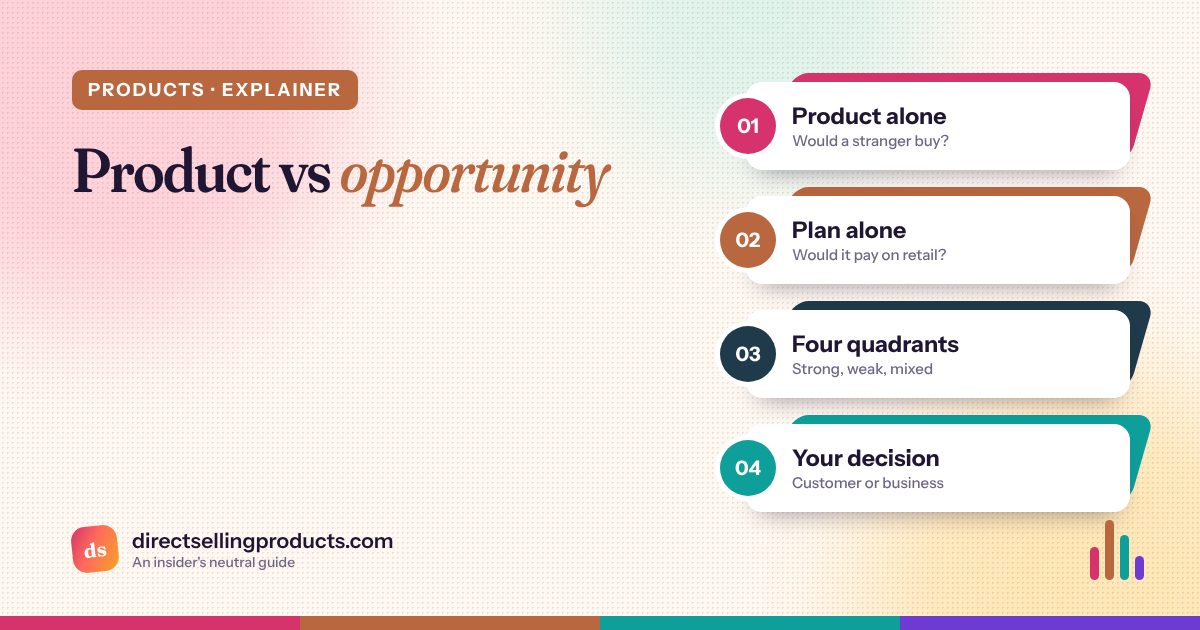
- Test the product alone, and the plan on retail alone.
- Strong product plus strong plan is rare. Strong product, modest plan is workable.
- Weak product plus rich plan is the riskiest combination.
Is direct selling about the product or the opportunity?
In healthy direct selling, the product comes first: customers who aren't sellers buy it, re-order it and would pay its full price without any business attached. The opportunity, meaning the compensation plan and team, is built on that demand. Where the product is only a reason to join, the structure is at risk.
Two tests, run separately
Test 1: The product, with no business
- Would a stranger buy it at the MRP?
- Is there a repeat reason: does it run out?
- Is it priced fairly per use? How to check →
- Does the label and claim set stand up? 10 checks →
Test 2: The plan, on retail alone
- If you recruit nobody, what can you earn from retail margin and customer re-orders?
- What is the monthly cost of staying active?
- Could you break even with a realistic customer list? Break-even maths →
The four combinations
Product strength vs plan richness
A rough way to think about risk. Not a rating of any company.
Why the weak-product, rich-plan corner is the risky one
If customers outside the network don't want the product, the money has to come from somewhere else: new sign-ups, or members buying to qualify. That's the pattern regulators look for in pyramid schemes. A rich plan on a product nobody would buy at full price is a warning, not a bonus.
How to decide
- Try the product as a customer for a month or two, before joining.
- Ask for the customer price and whether you can buy without any membership.
- Run the retail-only numbers for the plan.
- If it only works with a team, treat it as a business with costs, risks and a very uncertain outcome. Read how direct sellers actually earn.
Frequently asked questions
Should I join for the product or the business?
Start with the product. If you wouldn't buy it as a customer at its full price, the business will rest on weak foundations. If you like the product, the business can be a bonus rather than the reason.
Can a company have a great plan but weak products?
It can, but that combination usually depends on recruiting more than on customers. Regulators look closely at plans where the money comes mainly from sign-ups and members' own purchases.
What if I just want to be a customer?
A good company lets you. Ask what the customer price is, whether there's a membership fee, and whether you can leave without penalty.
Sources
- U.S. FTC Consumer Advice: Multi-Level Marketing Businesses and Pyramid Schemes. consumer.ftc.gov
- U.S. FTC: Business Guidance Concerning Multi-Level Marketing. www.ftc.gov
- Department of Consumer Affairs, India: Consumer Protection (Direct Selling) Rules, 2021. consumeraffairs.nic.in