Key takeaways
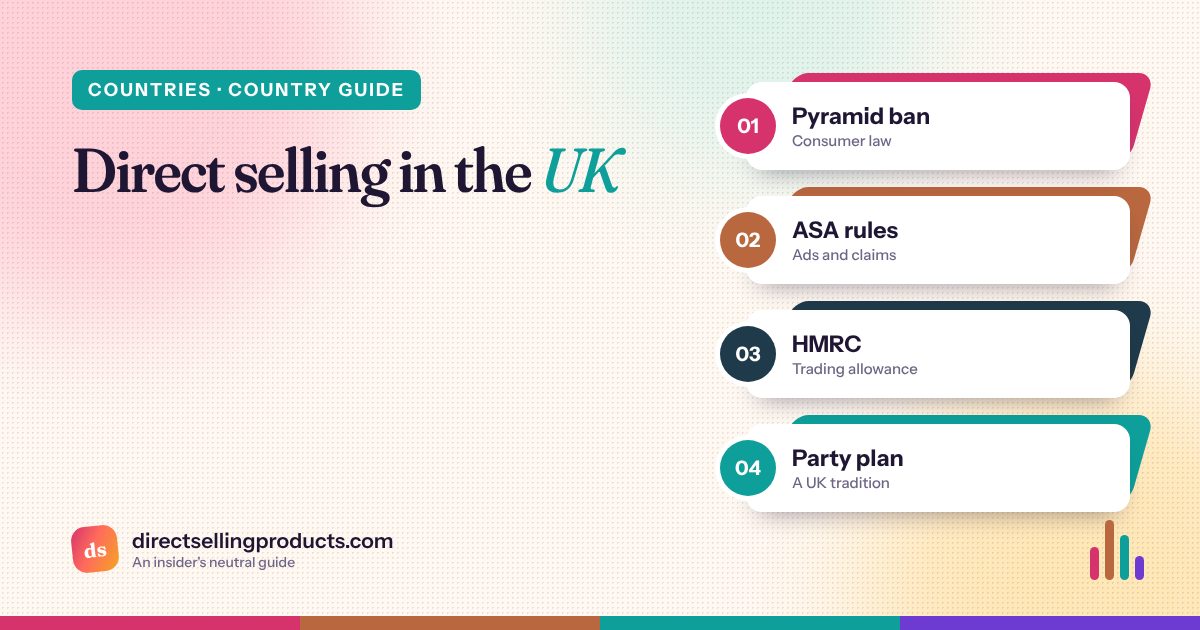
- Direct selling is legal. Pyramid schemes are banned.
- The ASA polices ads, including social posts. Health and income claims are the risk.
- The trading allowance and Self Assessment decide whether you report income.
Is direct selling legal in the UK?
Yes. Direct selling and party plans are legal in the United Kingdom, but pyramid selling schemes, which reward participants mainly for recruiting rather than selling, are prohibited under UK trading-schemes and consumer-protection law. Advertising, including claims on social media, is regulated by the Advertising Standards Authority.
This is general information, not legal advice. Consumer law was restated in 2024-25, so confirm current rules on GOV.UK.
The rules that matter most
| Area | What it means for sellers | Where to check |
|---|---|---|
| Pyramid selling | Schemes that pay mainly for recruitment are banned | Trading Standards; Competition and Markets Authority |
| Advertising | Claims on websites and social media must be honest, evidenced and not misleading; no medical claims for non-medicines | Advertising Standards Authority (CAP Code) |
| Cosmetics | Products must be safe and notified in the UK system by the responsible person | Office for Product Safety and Standards guidance |
| Food supplements | Only authorised nutrition and health claims; clear labelling | Food Standards Agency guidance |
| Distance selling | Customers have cancellation rights for many online and doorstep sales | Consumer Contracts Regulations (GOV.UK) |
Tax: trading allowance and Self Assessment
- Trading allowance: a limited amount of gross trading income each tax year is tax-free and need not be reported. Above it, you usually register with HMRC and file a Self Assessment return.
- Costs: if you claim expenses instead of the allowance, keep receipts for stock, postage and tools.
- VAT: only if your taxable turnover passes the registration threshold, which changes over time.
- National Insurance: self-employed contributions may apply above a profit level.
Check the current figures on GOV.UK or with an accountant. For the US equivalent, see 1099 and Schedule C.
How selling differs around the UK
Small flats, long commutes
Home parties are hard to host in a one-bed in Zone 3, so selling moves online and into the Tube-length message thread. Central heating in winter dries skin and lips, and customers are price-aware and compare with high-street shops instantly.
Strong community networks
School gates, community centres and workplace groups still matter. Faith and cultural communities in both cities buy through trusted contacts, and product suitability for different skin and hair types gets real attention.
Damp, dark winters
Long dark months, cold wind and damp make hand creams, vitamin D and home comforts steady sellers. Rural Highland deliveries can take longer, and weather can disrupt them.
Cardiff and market towns
Local Facebook groups and village fairs carry much of the trade. Welsh-language customers appreciate small gestures, and community trust travels fast, in good ways and bad.
How UK customers buy
- Party-plan tradition. Home parties, coffee mornings and catalogue ordering have deep roots, and have moved onto Facebook groups and video calls.
- Gifting seasons. Christmas dominates, followed by Mother's Day and Valentine's Day.
- Payments. Bank transfer, card readers and payment apps; cash is rare.
- Caution about "MLM". Many customers have seen the term in the press. Honest information and no hard sell go a long way.
Staying inside the rules
- Don't post income screenshots or lifestyle claims. They are exactly what the ASA investigates.
- Describe products as the label and company literature do.
- Declare that you're an independent seller and name the company.
- Apply the standard checks: red flags and the pyramid tests.
Frequently asked questions
Is direct selling legal in the UK?
Yes. Direct selling and party plans are legal in the UK. Pyramid selling schemes, where participants are rewarded mainly for recruiting, are prohibited under UK trading-schemes and consumer-protection law. Check current legislation, because the unfair-practices rules were restated in the Digital Markets, Competition and Consumers Act 2024.
Can I make health claims about products I sell in the UK?
Only within the rules. Food supplements and cosmetics are tightly controlled, and the Advertising Standards Authority enforces the CAP Code on social media too, including bans on claiming a product treats or cures a medical condition.
Do I pay tax on side income from selling?
Generally yes, but the trading allowance lets you earn a limited amount of trading income each tax year without reporting it. Above that, you usually register for Self Assessment. Check GOV.UK, because limits and rules change.
Sources
- GOV.UK: Starting a business and trading allowance. www.gov.uk
- Advertising Standards Authority (UK). www.asa.org.uk
- Competition and Markets Authority (UK). www.gov.uk
- World Federation of Direct Selling Associations. wfdsa.org