Key takeaways
- Direct selling products are sold person-to-person by independent sellers, not mainly through shops.
- The usual categories are wellness, beauty and personal care, and home care.
- Prices have layers (MRP, distributor price, points). Compare cost per use.
- The strongest products are re-ordered, not bought once.
What are direct selling products?
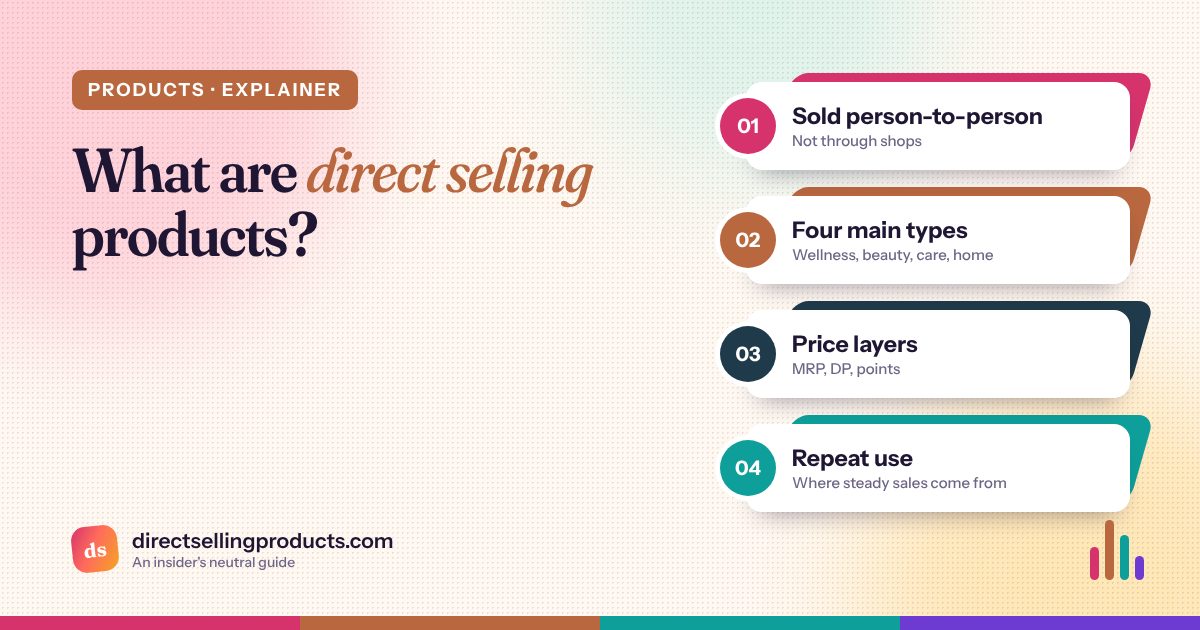
Direct selling products are goods sold person-to-person by independent sellers instead of through shops. The common categories are wellness supplements, skincare, cosmetics, personal care and home cleaning. Sellers earn a retail margin, and in most companies a commission on sales made by people they introduce.
That's the definition; the rest of this guide shows what it means in practice.
The four types you'll meet most often
| Type | Typical products | Why direct selling suits it |
|---|---|---|
| Wellness and nutrition | Daily supplements, protein, herbal products | Customers want guidance and a trusted person to ask |
| Skincare and beauty | Moisturisers, serums, colour cosmetics | Products can be demonstrated and sampled |
| Personal care | Toothpaste, soap, shampoo, deodorant | Everyday consumables, repeat purchases |
| Home care | Cleaners, detergents, dishwash concentrates | Results are visible in a demo; concentrates reward explanation |
Other categories exist, including cookware, water purifiers, jewellery and farm inputs. See the full category guide and agri products.
How these products reach customers
- The company makes or sources the product and sets its MRP.
- An independent seller buys at a lower distributor price, or the company ships directly to the customer on the seller's behalf.
- The seller recommends and demonstrates it, often by message, in homes or online.
- The customer pays the MRP. The seller keeps the difference, and may earn commission on the product's points.
Why the price has layers
Three numbers usually sit on a price list: the MRP (what the customer pays), the distributor price (what the seller pays) and the points (PV or BV, which drive commission and ranks). How they fit together →
Prices often look high because packs are large or concentrated. A product that makes 150 uses costs less per use than one that makes 50, even if the bottle price is higher. Work out cost per use →
What separates a strong product from a weak one
- Repeat use. It runs out and customers re-order.
- Verifiable licences. The label carries numbers you can check.
- Modest claims. No cures and no guaranteed results.
- Sells without the business. A stranger would buy it at the MRP.
Use the 10-check product guide to score any product.
This site explains features and how to judge products. It doesn't say which products are good or bad. That's for you, and where health is involved, a qualified professional, to decide.
Frequently asked questions
What is the difference between direct selling products and retail products?
Retail products are sold through shops or online marketplaces to anyone. Direct selling products are sold through independent sellers who demonstrate and recommend them in person or online, and who earn a margin and sometimes commission. The product itself can be identical in quality terms; the sales channel and price structure differ.
Are direct selling products more expensive?
Not always. Pack prices often look high because products are concentrated or sold in larger sizes, but cost per use can be comparable. Compare price per use rather than price per pack.
Can I buy direct selling products without joining?
Usually yes. Most companies let you buy as a customer through a seller or the company's own site. Joining should not be required to buy.
Sources
- Department of Consumer Affairs, India: Consumer Protection (Direct Selling) Rules, 2021. consumeraffairs.nic.in
- U.S. FTC Consumer Advice: Multi-Level Marketing Businesses and Pyramid Schemes. consumer.ftc.gov
- World Federation of Direct Selling Associations. wfdsa.org