Key takeaways
- Find the licence or Supplement Facts panel first. No licence, no sale.
- Check serving size, dose per serving and servings per pack to compare real cost.
- Disease cure claims are a red flag. Honest labels describe what the product is.
How do you read a supplement label?
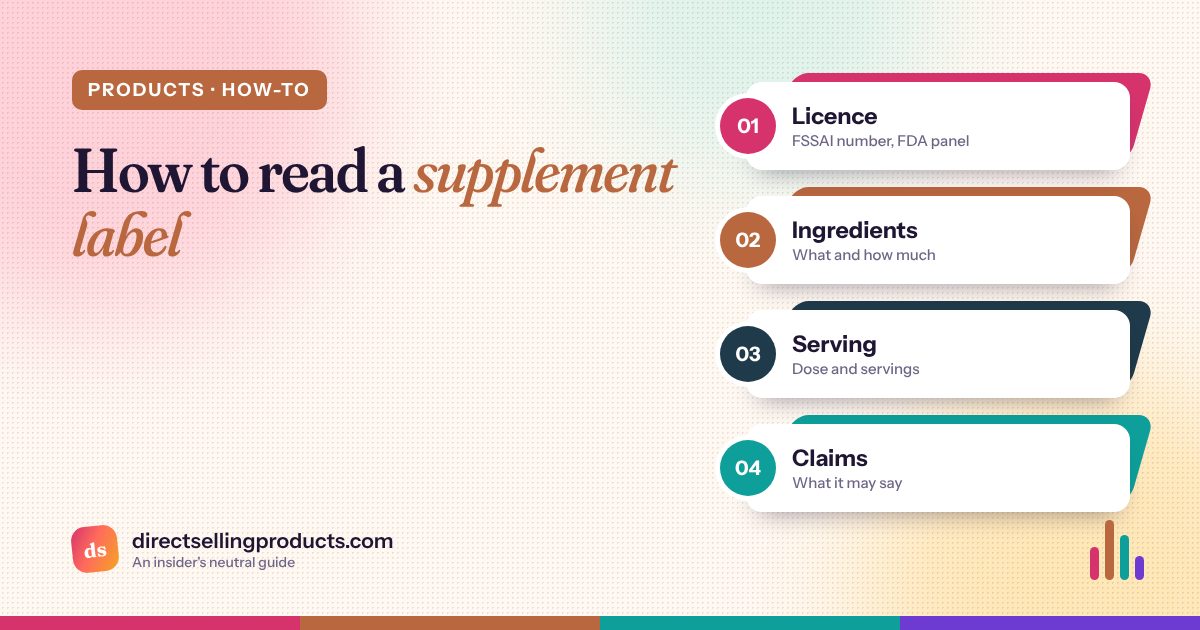
To read a supplement label, find the regulator's licence number or the Supplement Facts panel, check the ingredient list and the amount per serving, note the serving size and servings per pack, read the warnings and expiry, and treat any claim to cure or treat a disease as a red flag.
This guide gives general information, not medical advice. Always speak to a doctor if you have a health condition or take medicines.
1. Find the licence or registration
- India: look for the FSSAI logo and licence or registration number (14 digits) on the pack. You can verify it with FSSAI's licence lookup.
- USA: there's no licence number. Look for a Supplement Facts panel and the name and address of the manufacturer or distributor.
2. Read the ingredients and their amounts
Ingredients appear in order of weight. A "proprietary blend" lists a total amount but not each ingredient's amount, so you can't tell the dose of each. Prefer labels that show the amount of each active ingredient per serving.
3. Check serving size and servings per pack
All amounts are per serving, not per pack. Multiply to find your real daily cost and how long a pack lasts.
| Product | Pack price | Servings per pack | Cost per serving |
|---|---|---|---|
| Product A | ₹900 | 30 (1 a day) | ₹30.00 |
| Product B | ₹1,200 | 60 (1 a day) | ₹20.00 |
4. Read the warnings and directions
Look for who should avoid it (pregnancy, children, medication), maximum daily intake, and storage. If there are none, ask why.
5. Check batch and expiry
Batch number, manufacture date and expiry should be clear. Don't sell or use products that are close to or past expiry.
6. Read the claims, carefully
| Type of claim | Example | How to treat it |
|---|---|---|
| Describes the product | "Contains vitamin D and zinc" | Fine if the label matches |
| General support | "Supports general wellbeing" | Acceptable if modest |
| Specific effect | "Improves energy" | Ask for the basis; be careful repeating it |
| Disease claim | "Cures diabetes", "treats arthritis" | Red flag. Don't sell or repeat it |
In the USA the standard label disclaimer says the statements haven't been evaluated by the FDA. In India, advertising cures for certain listed diseases is restricted. See the company red flags →
If you are a seller
- Say only what's on the label and in official company literature.
- Never suggest a supplement as a substitute for medicine.
- Send people to a doctor when they describe symptoms or conditions.
- Keep the pack and invoice details in case of a complaint.
Score a whole product with the 10-check guide.
Frequently asked questions
Does an FSSAI licence mean a supplement is effective?
No. A licence or registration number shows the business is registered with the food-safety regulator. It doesn't prove the product works. Check the ingredients, dose and claims separately.
What does "not evaluated by the FDA" mean on a US supplement?
US dietary supplements aren't approved by the FDA for effectiveness before they're sold. The label carries a statement that claims haven't been evaluated and that the product isn't intended to diagnose, treat, cure or prevent any disease.
Should I talk to a doctor before taking a supplement?
Yes, especially if you're pregnant, nursing, on medication or have a medical condition. Nothing on this site is medical advice.
Sources
- Food Safety and Standards Authority of India. www.fssai.gov.in
- U.S. FDA: Dietary supplements. www.fda.gov
- U.S. FTC Consumer Advice: Multi-Level Marketing Businesses and Pyramid Schemes. consumer.ftc.gov