Key takeaways
- Income isn't profit. Subtract stock you don't use, events, tools and delivery.
- Judge the business by net earnings per hour, using the median experience.
- Most dependable earnings come from repeat customers, not one big month.
How do direct sellers earn money?
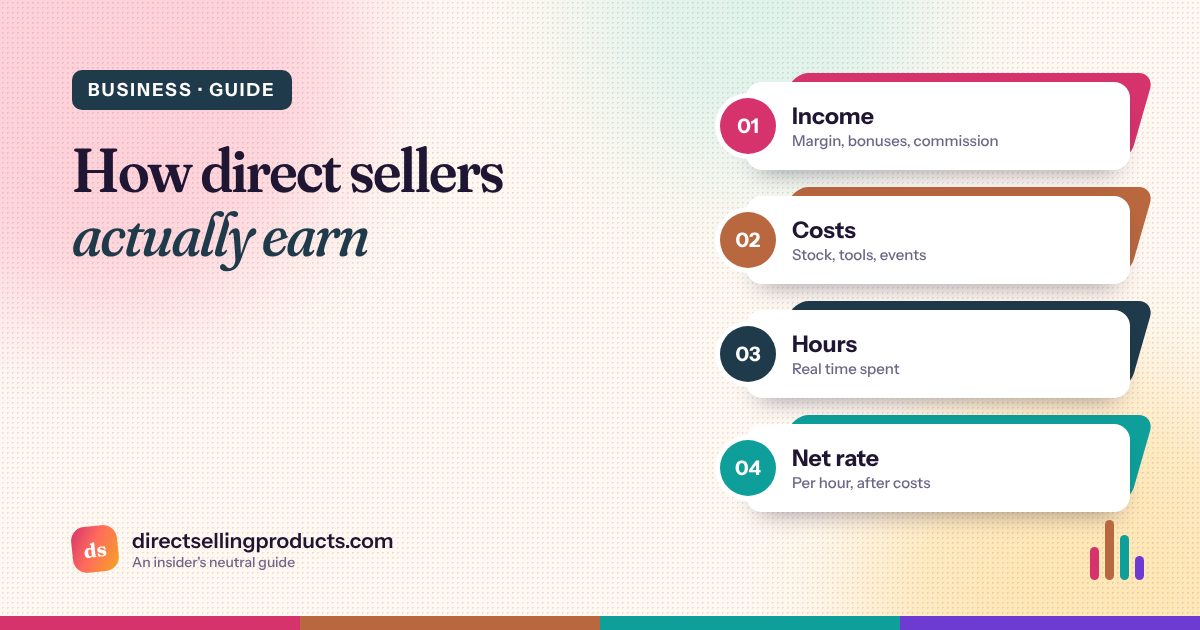
Direct sellers earn money from the retail margin on products they sell, bonuses tied to their own sales volume, and commissions on the sales volume of the team they sponsored. What they keep is those earnings minus costs such as stock they don't use, events, delivery and tools, which is often far less.
From income to profit
| Line | Month 1 | Month 2 | Month 3 |
|---|---|---|---|
| Retail margin | ₹1,500 | ₹2,400 | ₹3,000 |
| Bonuses and commission | ₹0 | ₹300 | ₹500 |
| Gross income | ₹1,500 | ₹2,700 | ₹3,500 |
| Stock not used or sold | −₹2,000 | −₹800 | −₹300 |
| Events, delivery, tools | −₹600 | −₹500 | −₹500 |
| Net | −₹1,100 | ₹1,400 | ₹2,700 |
In this example, month one lost money and the business only turned positive once the seller stopped over-buying. That shape (a loss first, then a slow climb) is realistic for people who reach profitability at all.
The hourly-rate worksheet
- Net monthly earnings (from the table above): say ₹2,700.
- Total hours: selling, follow-ups, deliveries, training, travel and events. Say 30.
- Net hourly rate = ₹2,700 ÷ 30 = ₹90 per hour.
Compare that with your local minimum wage and with what the same time could earn elsewhere. It isn't the only measure of value (flexibility and learning matter), but it's the honest number.
Why the median matters more than the stars
Stage stories feature top earners. The company's income disclosure shows everyone. If the median participant earns little after costs, a typical beginner should expect the same until they have evidence to the contrary. How to read the statement →
What dependable earning looks like
- Repeat customers. The same people re-ordering consumables each month.
- Low fixed costs. No big monthly minimum you pay regardless of sales.
- Margins you understand. MRP, DP and PV are clear on the price list.
- A team is a bonus, not a necessity. You'd still break even without it.
Warning signs in income stories
- Income quoted without costs.
- "Up to" or "potential" earnings instead of what was paid.
- One month used as if it were every month.
- Lifestyle photos in place of numbers.
If you see several of these, read the red flags checklist. For how the plan itself pays, see compensation plans explained.
Frequently asked questions
How much do direct sellers earn?
It varies enormously. Company income disclosure statements typically show that a small share of participants earns most of the money and that many earn little or nothing, especially after costs. Read the median and the share earning nothing in the company's own statement.
Is direct selling a good full-time job?
For most participants it is a part-time activity. Whether it works as a full-time income depends on the company, your customer base, your costs and your market. Judge it on after-cost earnings and hours worked.
What is a realistic number of hours?
Track your own. Time spent on customers, deliveries, follow-ups, training and events all count. Dividing your net monthly income by your total hours gives an honest hourly rate.
Sources
- U.S. FTC Consumer Advice: Multi-Level Marketing Businesses and Pyramid Schemes. consumer.ftc.gov
- U.S. FTC: Business Guidance Concerning Multi-Level Marketing. www.ftc.gov
- Department of Consumer Affairs, India: Consumer Protection (Direct Selling) Rules, 2021. consumeraffairs.nic.in