Key takeaways
- Red flags show where to dig, not proof of wrongdoing. Each one has a question that settles it.
- Some flags are walk-away flags: guaranteed income, pay for recruiting, no buy-back, no income disclosure.
- Count them. One or two: ask in writing. Three or four: slow down. Five or more: don't join yet.
- Honest companies and teams answer these questions easily. Dodging them is the biggest flag of all.
What are the red flags of an MLM?
The main red flags of an MLM are income guarantees, pay that depends mainly on recruiting, large upfront or monthly purchases to stay qualified, no written buy-back policy, no income disclosure statement, pressure to decide quickly, and a team that discourages questions or outside research.
- Guaranteed or "passive" income claims
- Pay that depends mainly on recruiting
- Large joining or stock purchases needed to qualify
- No written buy-back or cooling-off policy
- No income disclosure statement
- Pressure to decide fast
- Discouraging questions or outside research
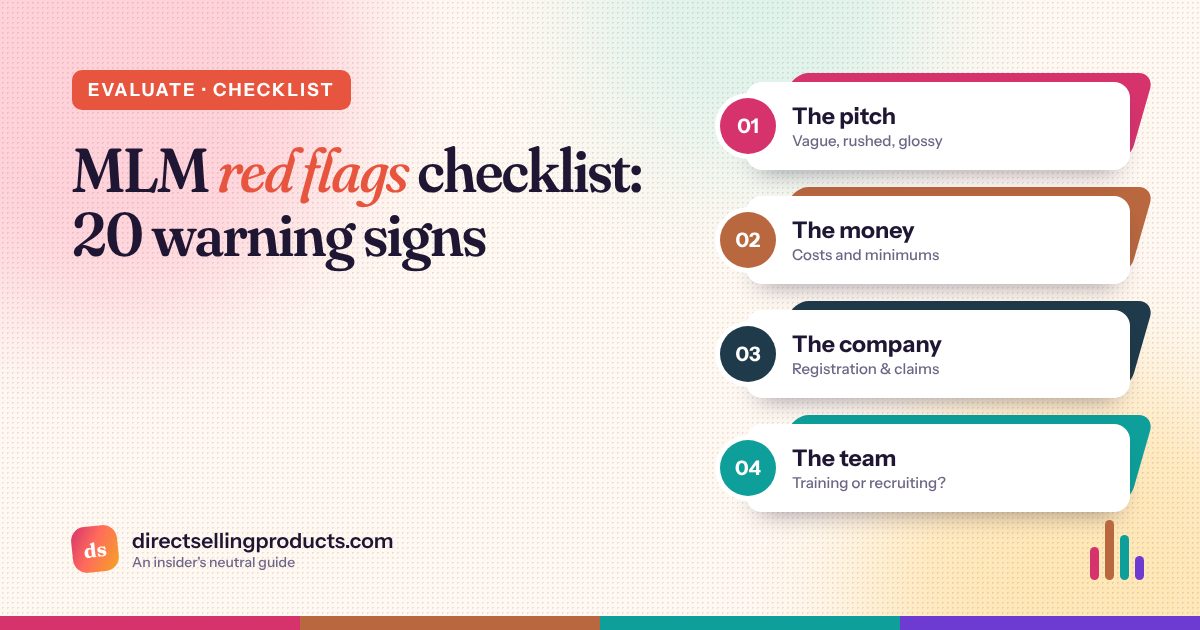
That's the short list. Below are 20 signs in four groups, each with why it matters and a question to ask. If you only have two minutes, the red-flag checker on the home page covers the seven most common.
Not all flags weigh the same
A rough guide to how to treat each kind. It's a judgement aid, not a legal test.
Group 1: The pitch (5 signs)
You see these before you've read a single document.
| # | Red flag | Why it matters | Ask this |
|---|---|---|---|
| 1 | Vague invitation. "Come to a meeting, I can't say what it is." | Honest offers can be described in a sentence. | "What's the company and the product? I'll decide whether to come." |
| 2 | Lifestyle display. Cars, trips and luxury as the main proof. | Shows the top few, not what a typical participant earns. | "What does the income disclosure say a typical participant earns?" |
| 3 | "Guaranteed" or "passive" income. | Income depends on sales and effort. Guarantees are a misleading-claim risk with regulators. | "Where is that figure published by the company?" |
| 4 | Urgency. "Spots are limited," "price goes up Friday." | Pressure takes away time to check. A real opportunity will wait a week. | "If I decide next week, what changes in writing?" |
| 5 | Questions are discouraged. "Don't Google it," "negative people." | Legitimate companies welcome scrutiny. | "Can I take the documents away and read them?" |
Group 2: The money (5 signs)
| # | Red flag | Why it matters | Ask this |
|---|---|---|---|
| 6 | Large joining fee or starter kit. | You're paying before you've sold anything. In India the 2021 rules say direct sellers shouldn't be required to pay an entry or registration fee. | "Can I join without buying a kit? What happens if I return it?" |
| 7 | Monthly purchase needed to stay "active". | It turns a sales business into a subscription you pay for. | "What's the minimum monthly purchase, and what happens if I skip it?" |
| 8 | Ranks or bonuses that require stock buying. | Stock bought to hit a rank isn't real retail demand. | "Which bonuses can I earn from customer sales alone?" |
| 9 | No written buy-back or cooling-off policy. | Leaves you holding unsold stock. | "Send me the buy-back policy as a document or link." |
| 10 | No income disclosure statement. | Without it, every income claim is unverified. | "What share earned nothing? What's the median?" |
To read flag 10 properly, see how to read an income disclosure statement. These two guides explain the thinking behind the money flags: direct selling vs pyramid scheme and the 9-check method.
Group 3: The company (5 signs)
| # | Red flag | Why it matters | Ask this |
|---|---|---|---|
| 11 | No registered office or grievance officer. | If something goes wrong, there's nobody to complain to. Indian rules expect both. | "What's the registered address and the grievance officer's contact?" |
| 12 | Compensation plan only in a team's slides. | Teams simplify or exaggerate. The official document is what applies. | "Show me the plan on the company's own website." |
| 13 | Disease cure claims. | Products that claim to cure serious diseases are a legal risk for the company, and for you if you repeat the claim. In India, advertising cures for certain listed diseases is restricted under the Drugs and Magic Remedies Act, 1954. | "Where is that claim approved or substantiated?" |
| 14 | Products priced far above comparable ones. | If it only sells to members, the price is probably about the commission, not the product. | "What's the cost per use compared with a shop equivalent?" |
| 15 | Hidden ownership or frequent name changes. | You can't judge the track record of a company you can't identify. | "Who owns the company, and how long has it operated under this name?" |
Group 4: The team (5 signs)
Your day-to-day experience depends on your upline as much as on the company.
| # | Red flag | Why it matters | Ask this |
|---|---|---|---|
| 16 | Upline can't name retail customers. | If nobody outside the network buys, the business sells to itself. | "Who were your last five customers who aren't sellers?" |
| 17 | Training is mostly about recruiting. | Signals that the money is in sign-ups, not sales. | "What share of training is about the product and customers?" |
| 18 | Paid extras. Costly events, courses, "systems" or tools. | The team leader may earn from what sellers spend. | "Which of these are optional, and who benefits from the fees?" |
| 19 | Pushed to recruit family and close friends first. | Puts relationships at risk for a business you haven't tested. | "How would I start with customers outside my family?" |
| 20 | Stock-up pressure at month end. | Month-end purchases to hit targets are a classic sign of inventory loading. | "What happens to my rank if I don't buy this month?" |
How many red flags is too many?
Count the signs that apply. There's no official number, so use this as a practical rule:
| Flags | What it suggests | What to do |
|---|---|---|
| 0 to 2 | Common issues, often fixable | Ask the matching questions and get answers in writing. |
| 3 to 4 | A pattern worth worrying about | Slow down. Compare with at least one other company and read the income disclosure. |
| 5 or more | A serious pattern | Don't join until the walk-away flags are resolved. Consider talking to someone independent. |
| Any walk-away flag | Guaranteed income, pay for recruiting, no buy-back or no disclosure | Pause, whatever the count, until it's fixed in writing. |
Green flags: what a healthier setup looks like
Red flags are only half the picture. These are signs that a company and team are easier to trust:
- Customers first. Your upline can describe real repeat customers who aren't sellers.
- Low cost to start. The kit is optional and priced like products you'd use anyway.
- Documents on request. Compensation plan, income disclosure and buy-back policy come as links, not promises.
- Honest numbers. Typical earnings are described, not just top ranks.
- Room to say no. Nobody minds when you want a week, or want to be only a customer.
- Identifiable company. Registered office, grievance officer and years of operating history are easy to find.
Seeing green flags doesn't make a company a good fit. It means the questions above will probably get straight answers.
What to do if you've spotted several
- Don't pay yet. Nothing legitimate disappears in 48 hours.
- Send your questions by message or email so the answers are in writing.
- Check the facts yourself: the company's registration, its published income disclosure and its buy-back policy.
- Get a neutral second opinion. You're welcome to send me your question by email.
If you've already paid and think you were misled, see the steps at the end of our pyramid scheme guide.
Frequently asked questions
What are the biggest red flags in an MLM?
The most serious are guaranteed or "passive" income claims, pay that depends mainly on recruiting, large upfront or monthly purchases needed to stay qualified, no written buy-back policy, and refusal to show an income disclosure. Any one of these deserves an answer in writing before you pay.
How many red flags are too many?
There is no official number. As a practical rule: one or two flags means ask for answers in writing; three or four means slow down and compare with another company; five or more, or any single flag from the walk-away list, means don't join until it is resolved.
Can a legitimate MLM have red flags?
Yes. A lawful company can still have a pushy team, an expensive starter kit or confusing minimums. Flags tell you where to dig, not that the company is illegal. What matters is whether the company and your upline can answer the question beside each flag clearly and in writing.
Is it a red flag if my friend invited me without saying what it was?
A vague invitation is a common one. Honest invitations say what the product or business is. It's reasonable to reply, "Tell me what it is and the company name first, and I'll decide whether to come."
Sources
- U.S. FTC Consumer Advice: Multi-Level Marketing Businesses and Pyramid Schemes. consumer.ftc.gov
- U.S. FTC: Business Guidance Concerning Multi-Level Marketing. www.ftc.gov
- Department of Consumer Affairs, India: Consumer Protection (Direct Selling) Rules, 2021. consumeraffairs.nic.in
- National Consumer Helpline, India. consumerhelpline.gov.in
- U.S. FTC: Report fraud. reportfraud.ftc.gov