Key takeaways
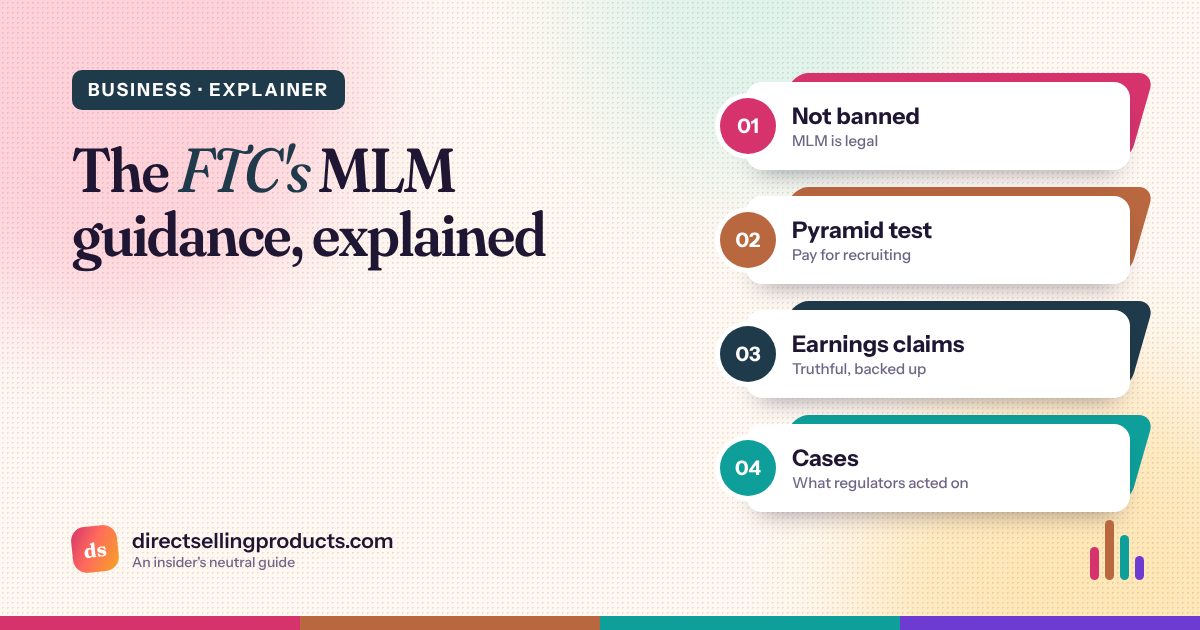
- MLM is legal. A pyramid scheme is not.
- The FTC asks whether pay comes from real retail sales or from recruiting and members' own purchases.
- Earnings claims must be truthful and backed up. A disclaimer doesn't fix a misleading message.
What does the FTC say about multi-level marketing?
The FTC says multi-level marketing is legal when participants are paid mainly for selling products to genuine customers, and illegal when it operates as a pyramid scheme paying mainly for recruitment. It also requires that any earnings claims be truthful and substantiated, and that overall impressions not mislead.
This is a plain-English summary of public guidance and case outcomes. Check ftc.gov for the current text.
The pyramid-scheme test
- Where does the money come from? Sales to real customers, or payments by participants.
- What is rewarded? Retail sales, or recruiting and sign-ups.
- Are participants buying to qualify? Purchases made to hit targets or ranks aren't the same as retail demand.
The FTC's traditional test looks at whether participants pay for the right to sell and to receive rewards for recruiting that are unrelated to product sales to end users. Our own version is in direct selling vs pyramid scheme.
Earnings claims
| Principle | What it means in practice |
|---|---|
| Truthful | Claims must be accurate for the audience who'll see them |
| Substantiated | You need evidence for a claim before you make it |
| Typical results matter | Showing exceptional earnings can mislead if it implies they are typical |
| Overall impression | Photos, lifestyle and language count, not just the numbers |
| Disclaimers have limits | Small print doesn't cancel a misleading message |
This is why income disclosure statements exist: they let a company show what participants really earn.
What enforcement cases show
| Case | What it illustrates |
|---|---|
| Amway (1979 decision) | A plan found lawful partly because of safeguards: buy-back and retail-sales rules. See our note on disclosure. |
| BurnLounge (2014, court of appeals) | A plan held to be a pyramid: most purchases were by participants for qualification |
| Herbalife (2016 settlement) | A company agreed to change how it operates and pay a large settlement, without admitting wrongdoing |
What it means for you
- Prospects: ask for the income disclosure, and be sceptical of lifestyle displays.
- Sellers: don't repeat earnings claims you can't back. You can be responsible for what you say.
- Everyone: keep screenshots, messages and receipts. They help if something goes wrong.
If you think a company or team has misled you, here are the steps. In the USA, report it through the FTC's ReportFraud site and your state attorney general. For tax, see 1099 and Schedule C.
Frequently asked questions
Is MLM legal according to the FTC?
Yes. The FTC treats multi-level marketing as lawful when participants are paid mainly for selling products to real customers. It is unlawful when it works as a pyramid scheme, where rewards depend mainly on recruitment.
Do disclaimers fix a misleading earnings claim?
Not by themselves. The FTC's view is that the overall impression of a claim matters, so a small disclaimer doesn't cure a message that suggests typical income is higher than it is.
Where do I report an MLM I think is deceptive?
In the USA, use the FTC's ReportFraud site, and also contact your state attorney general. Keep copies of any income claims and communications.
Sources
- U.S. FTC: Business Guidance Concerning Multi-Level Marketing. www.ftc.gov
- U.S. FTC Consumer Advice: Multi-Level Marketing Businesses and Pyramid Schemes. consumer.ftc.gov
- U.S. FTC: Report fraud. reportfraud.ftc.gov