Key takeaways
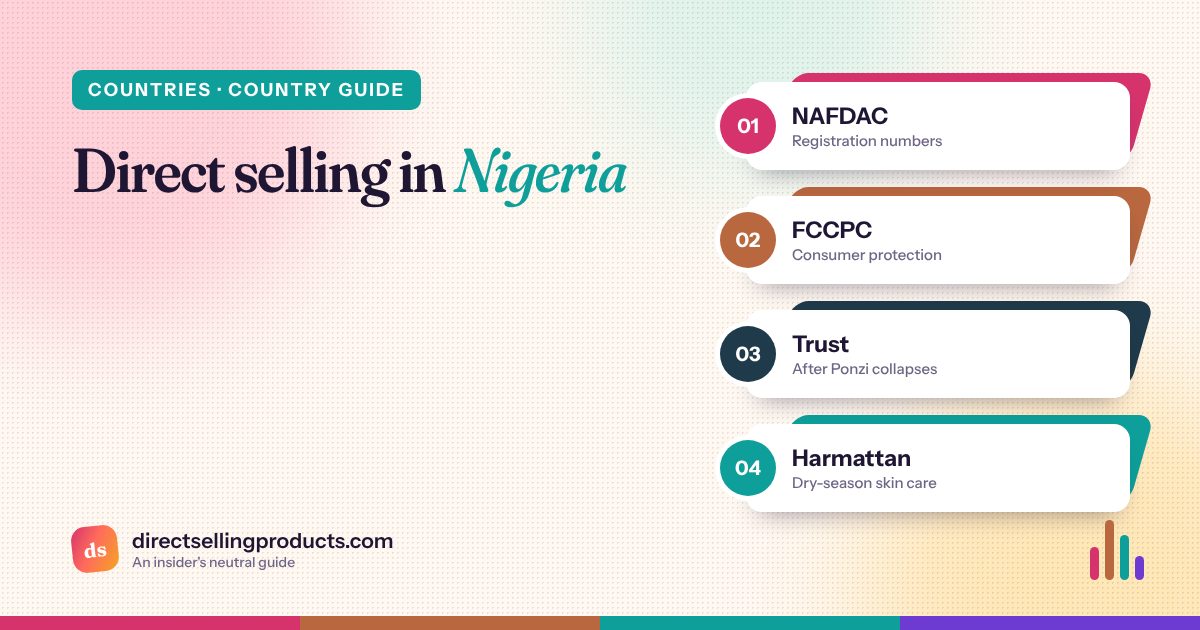
- Look for a NAFDAC number on foods, supplements and cosmetics, and verify it.
- Be transparent: many customers have seen schemes collapse and want proof.
- Climate matters: the harmattan dry season changes what customers need.
Is direct selling legal in Nigeria?
Direct selling is lawful in Nigeria, but regulators have repeatedly warned about Ponzi and pyramid schemes. Consumer protection is handled by the Federal Competition and Consumer Protection Commission, and food, supplement and cosmetic products need NAFDAC registration. Verify the company, the product numbers and the refund terms before joining.
General information, not legal advice. Confirm current rules with the agencies named.
Local checks
| Body | What to check |
|---|---|
| Corporate Affairs Commission (CAC) | Is the company or business name registered, and who owns it? |
| NAFDAC | Does each food, supplement or cosmetic carry a valid registration number? |
| FCCPC | Consumer-protection rules and complaints |
| SEC Nigeria | Public warnings about schemes presented as investments |
How selling differs across Nigeria
Ikeja, Lekki, Yaba, Surulere
A city of long commutes and "go-slow" traffic, so orders move by WhatsApp and delivery riders rather than visits. Humid year-round heat and a long rainy season, roughly April to October, shape what people ask for. Income and lifestyle differ widely between mainland and island.
The planned capital
A civil-service and professional market with steadier salaries and an appetite for wellness and beauty. Cooler nights in some months, and a more formal tone, with people expecting registration details and receipts.
Oil city, wet climate
Heavy rain and humidity, and a customer base tied to the energy sector. Delivery reliability and power supply matter, and customers trust sellers they can meet.
Trading heartland
A centuries-old commercial city where Hausa is the lingua franca and reputation travels by word of mouth. In the dry season, harmattan winds bring dust, dry air and cracked lips and skin, so moisturisers and lip care sell strongly from about November to February.
What shapes buying
- Trust and proof. After Ponzi collapses, customers ask for registration, receipts and refund terms. Show them freely.
- Counterfeits. Fake and expired products circulate. Buy from the company's authorised channels and keep batch details.
- Payments. Bank transfer and payment links are the norm, with POS agents in many areas. Always confirm payment before delivery, and be careful about fake transfer alerts.
- Prices. Currency swings change imported-product prices. Explain any price change clearly.
- Festive peaks. December is the biggest gifting period, followed by the major Muslim and Christian festivals.
- Languages. English and Pidgin work almost everywhere. Hausa, Yoruba and Igbo build rapport locally.
Tax and records
Register your business name with the CAC if you trade regularly, keep receipts, and confirm your obligations to federal and state tax authorities. Tax administration in Nigeria was being reformed recently, so check the current rules with an accountant.
Staying safe and fair
- Never present a scheme as an investment. Direct selling is about products, not returns.
- Check the NAFDAC number before you sell any product.
- Apply the checks: pyramid tests, red flags, and for supplements, the label guide.
- Report problems to the FCCPC and NAFDAC, and keep records.
Frequently asked questions
Is direct selling legal in Nigeria?
Direct selling is lawful, but Nigerian regulators have repeatedly warned the public about Ponzi and pyramid-type schemes. Consumer protection falls under the Federal Competition and Consumer Protection Commission, and food and cosmetic products need NAFDAC registration. Verify both before joining.
How do I check a NAFDAC number?
Look for the NAFDAC registration number on the pack and verify it with NAFDAC's channels, such as its verification service. A missing or unverifiable number is a serious warning sign.
Why are Nigerians cautious about direct selling?
High-profile Ponzi collapses, including the MMM scheme and later "investment" platforms, left many people out of pocket, so people ask hard questions and look for proof. Being open about costs, refunds and registration helps.
Sources
- NAFDAC, Nigeria. www.nafdac.gov.ng
- Federal Competition and Consumer Protection Commission, Nigeria. fccpc.gov.ng
- Corporate Affairs Commission, Nigeria. www.cac.gov.ng
- World Federation of Direct Selling Associations. wfdsa.org