Key takeaways
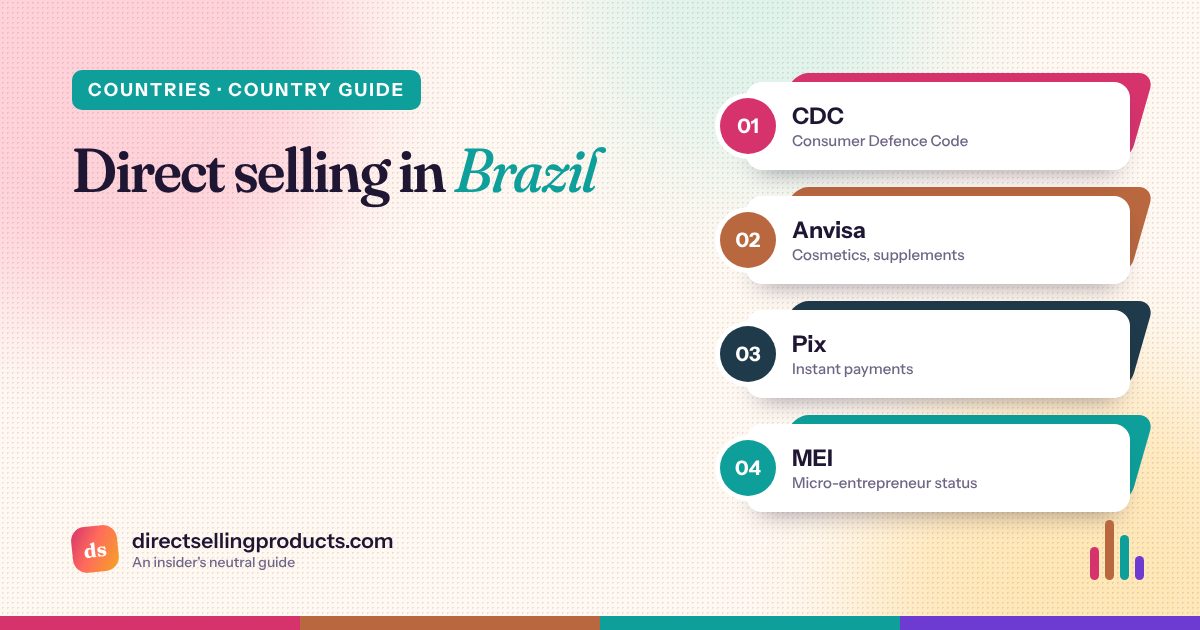
- The Consumer Defence Code gives customers strong rights, including withdrawal for some distance sales.
- Anvisa regulates cosmetics, supplements and sanitising products. Check registration or notification.
- Pix is the default way to pay. Regional climate and the calendar shape demand.
Is direct selling legal in Brazil?
Yes. Direct selling is a long-established channel in Brazil, protected for consumers by the Consumer Defence Code and, for health and cosmetic products, overseen by Anvisa. Financial pyramids are treated as a criminal matter. Check the company's registration and each product's registration before joining.
General information, not legal advice. Confirm current rules with the agencies named.
Who regulates what
| Body or law | What it covers |
|---|---|
| Consumer Defence Code (CDC) | Consumer rights: clear information, protection against abusive practices, rights to cancel in some distance sales |
| Procon | State and local consumer-protection bodies that take complaints |
| Anvisa | Cosmetics, supplements, sanitising products: registration or notification and labelling |
| Receita Federal | Tax registration (CPF, CNPJ) and the MEI regime |
| ABEVD | The industry association; membership is voluntary and not a guarantee |
How selling differs across Brazil
The country's largest market
Dense, fast and price-aware, with sellers working in offices and condos. The climate is mild and changeable, with a cool, drizzly winter, so product mixes shift with the weather. Traffic makes timed deliveries a selling point.
Heat, beach and body care
Hot, humid summers push body care, sunscreen, deodorant and hair products to the front, especially before Carnival. Sellers often work through gyms, beauty salons and neighbourhood groups.
Tropical, warm all year
Humidity and strong sun year-round. Lightweight, sweat-resistant products sell, and community and church networks carry a lot of trust. Delivery to the interior can be slow.
Cold, dry winters
Real cold from June to August, with frost in places, so rich creams, lip care and body butters sell in a way they wouldn't in Salvador. European-descended communities in the south have their own seasonal habits.
What shapes buying
- The revendedora tradition. Women reselling catalogue products to neighbours and colleagues for decades, often as a first source of independent income.
- Pix first. Instant payment is the default. Boletos and card instalments are also common.
- Card instalments. Paying in several instalments with no visible interest is a normal way to buy larger items.
- Calendar peaks. Mother's Day (second Sunday of May), Christmas and Black Friday.
- WhatsApp. Used for catalogues, orders and customer service.
- Portuguese. Customers expect clear Portuguese. Provide information in it.
Tax and records
Many small sellers formalise as an Individual Micro-Entrepreneur (MEI) for simplified registration and tax. There are limits on revenue and activity, and rules change, so check the current ones on the government portal. Keep records of sales and purchases.
Selling well in Brazil
- Give clear information. The CDC puts weight on transparent prices, terms and risks.
- Check Anvisa registration or notification on cosmetics and supplements.
- Be honest about the opportunity. Read the income disclosure and use the pyramid tests.
- Match products to the region. A winter range for the south is not a Salvador range.
Frequently asked questions
Is direct selling legal in Brazil?
Yes. Direct selling is a long-established channel in Brazil. Consumers are protected by the Consumer Defence Code, health products by Anvisa, and pyramid schemes are treated as a criminal matter. Check the company and product registration before joining.
What is MEI?
MEI, the Individual Micro-Entrepreneur regime, is a simplified way for small traders to formalise a business with a low-cost, simplified tax payment, up to an annual revenue limit. Eligibility, limits and rules change, so check the current ones with the tax authority.
What is Pix?
Pix is Brazil's instant payment system, used for everyday transfers 24 hours a day. It's the main way many customers pay sellers, often in seconds and at no cost.
Sources
- Anvisa, Brazil: health regulator. www.gov.br
- Receita Federal, Brazil. www.gov.br
- ABEVD: Brazilian direct selling association. www.abevd.org.br
- World Federation of Direct Selling Associations. wfdsa.org