Key takeaways
- A buy-back policy lets you return unsold, saleable stock for a refund.
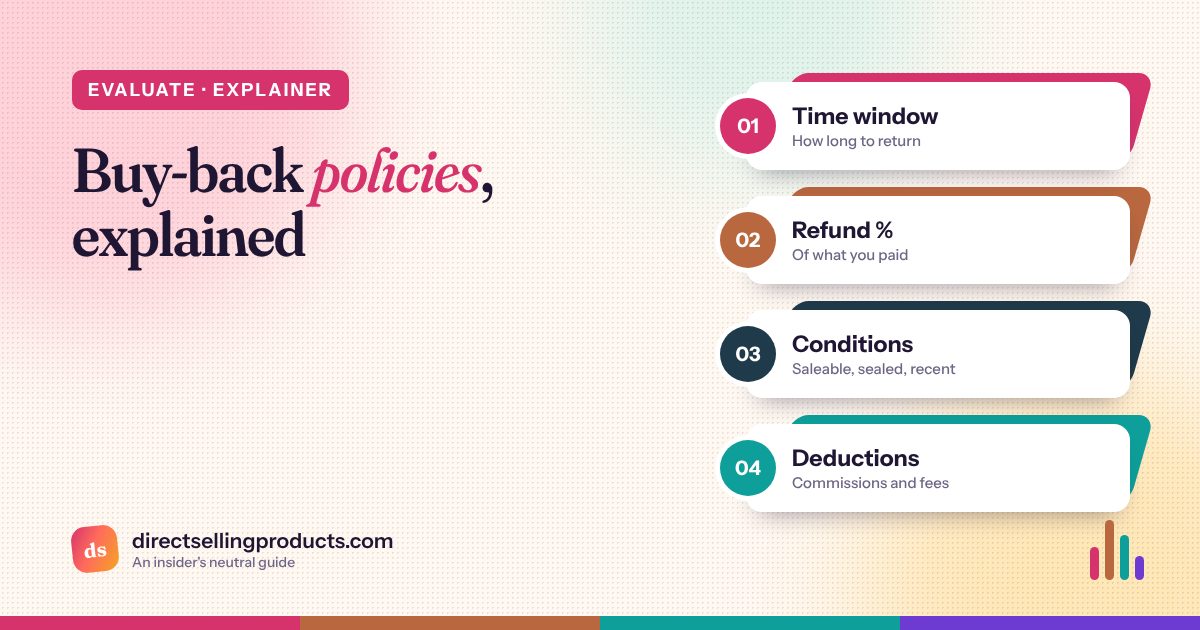
- Read four things: the time window, the refund percentage, the conditions and the deductions.
- Get it as a document or link from the company, not as a promise from a person.
What is a buy-back policy in direct selling?
A buy-back policy is a direct selling company's written promise to repurchase unsold, saleable products from a seller for a refund within a set period. A fair policy states the time window, the percentage refunded, the condition of returnable stock and any deductions, such as commissions already paid.
It matters most for the thing every new seller worries about, quietly: what if I can't sell it? A clear policy turns that from a loss into a manageable risk.
The four parts of a fair policy
| Part | What a fair policy says | Warning signs |
|---|---|---|
| Time window | A stated period (for example, many months) from purchase or from product expiry limits | No time stated; "at company discretion" |
| Refund amount | A high percentage of the net price you paid, stated as a number | Store credit only; steep, unexplained deductions |
| Condition of stock | Saleable: unopened, in original packaging, unexpired | Only "latest batch" or "current season" accepted |
| Deductions | Commissions and bonuses earned on returned goods are reversed; shipping explained | Hidden restocking fees; penalties on your rank |
For reference, the US Direct Selling Association's code of ethics asks member companies to repurchase saleable inventory for a year or more at a high percentage of the original cost. Confirm the current wording on the DSA site. India's 2021 rules expect a refund route too: see our legal check.
A worked example
This is an invented illustration. It shows why the deductions line matters as much as the percentage.
| Line | Policy A | Policy B |
|---|---|---|
| Refund percentage | 90%: ₹9,000 | 100%: ₹10,000 |
| Commission reversed | ₹0 (none paid) | ₹1,500 |
| Restocking fee | ₹0 | 10% of price: ₹1,000 |
| You receive | ₹9,000 | ₹7,500 |
Policy B looks more generous on the headline (100%) and pays less in the end. Always add up the deductions.
Six questions to ask before you buy stock
- Where is the written buy-back policy? Send me the link or PDF.
- How many months or days do I have to return stock?
- What percentage of my net price is refunded, in cash?
- Which products are excluded (seasonal, discounted, opened, expired)?
- What commissions or bonuses are reversed on returns?
- How do I request it, who approves it, and how long does the refund take?
How to protect yourself in practice
- Buy small. Start with what you'll use and what a customer has already asked for.
- Keep invoices and batch details. Returns need proof of purchase and condition.
- Log expiry dates. Most policies exclude near-expiry or expired items.
- Don't stock up to hit a rank. Buy-back reverses the bonus you bought the stock to earn. See the money flags.
- Return early if sales aren't coming. Waiting until the window closes is how people end up with unsellable stock.
If a company refuses a return its own policy allows, document it and use the steps in our pyramid scheme guide to complain.
Frequently asked questions
Is a buy-back policy a legal requirement?
It depends on the country. India's Consumer Protection (Direct Selling) Rules, 2021 expect direct selling entities to have a policy covering refunds or buy-back of unsold goods, and many industry codes ask the same. Check the current rules where you live, and treat a company without a written policy as a red flag.
Will I get a full refund on returned products?
Rarely a full 100%. Typical policies refund a high percentage of what you paid, within a time limit, for saleable stock, and deduct any commissions you earned on those products. The exact terms are what you need to read.
What if my upline says the policy isn't needed?
Ask the company directly, in writing. A policy that exists only as a promise from a team leader isn't a policy.
Sources
- Department of Consumer Affairs, India: Consumer Protection (Direct Selling) Rules, 2021. consumeraffairs.nic.in
- U.S. FTC: Business Guidance Concerning Multi-Level Marketing. www.ftc.gov
- Direct Selling Association (USA). www.dsa.org
- National Consumer Helpline, India. consumerhelpline.gov.in