Key takeaways
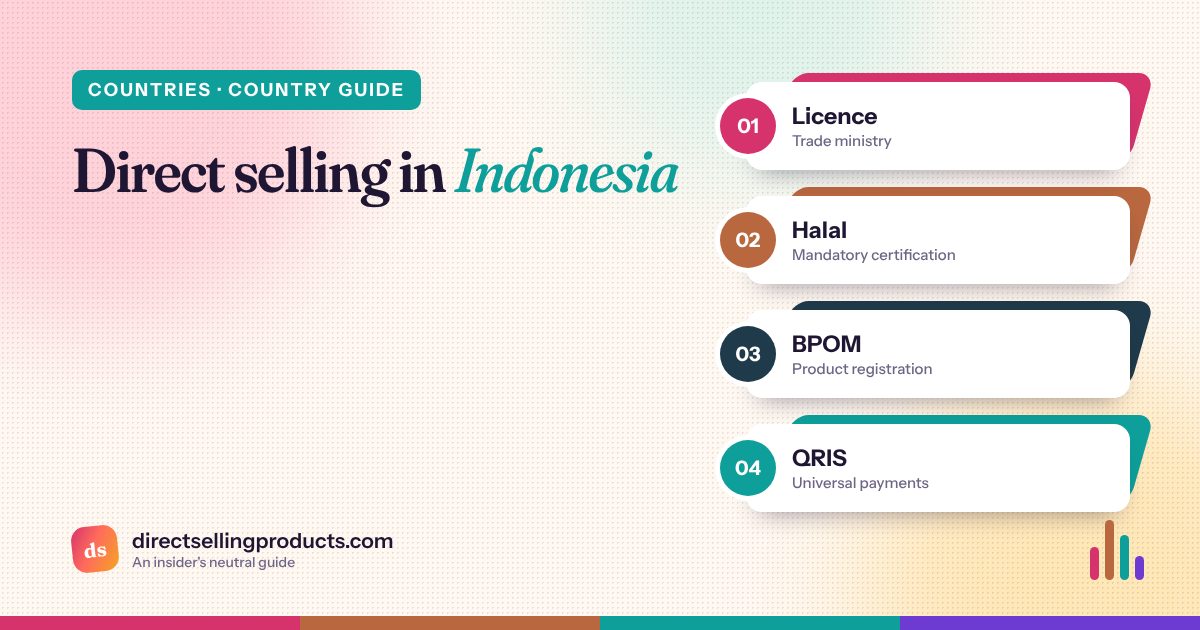
- Companies need a trade ministry licence. Ask for the number.
- Halal certification is being phased in and matters to most customers.
- Check the BPOM number on food, supplements and cosmetics.
- QRIS and e-wallets work nationwide. Logistics across islands decide delivery times.
Is direct selling legal in Indonesia?
Yes. Direct selling is legal in Indonesia, and direct selling companies operate under a licence from the trade authorities, with products subject to BPOM registration and halal rules. Pyramid-style schemes that pay mainly for recruitment are prohibited. Always verify the company's licence and its product numbers.
General information only. Rules in Indonesia change often, so confirm with the ministries named.
The four checks
| # | Check | With |
|---|---|---|
| 1 | Direct selling licence and company registration | Ministry of Trade and the company registry |
| 2 | BPOM registration or notification number on each product | BPOM |
| 3 | Halal certificate or required non-halal label | The halal product assurance agency (BPJPH) |
| 4 | Written terms, refunds and a way to complain | The company; consumer-protection bodies |
How selling differs across the islands
Commuter megacity
Hours on the KRL commuter line and in traffic make online ordering and doorstep delivery the norm. Heat and humidity are constant, with heavy rain between roughly November and March, and flood season disrupts both customers and couriers.
Java's second and third cities
Surabaya is a trading city where bargaining and trust matter, while Bandung is a young, fashion- and campus-driven market. Cooler highland air around Bandung changes skincare choices compared with coastal Jakarta.
A multilingual trading hub
Medan mixes many communities, with strong Chinese-Indonesian, Batak and Malay networks. Referrals through church, mosque and family associations carry real weight.
Sulawesi and Denpasar
Makassar is the gateway to eastern Indonesia, where shipping time is the main challenge. Denpasar has a large tourism and expat customer base and a different cultural calendar from the rest of the country.
What shapes buying
- Ramadan and Lebaran. The weeks before Idul Fitri are the biggest gifting period of the year, especially for personal-care and household sets.
- Halal first. For many customers, certification decides the purchase before price does.
- QRIS and e-wallets. QRIS, a national QR standard, and wallets such as GoPay, OVO and DANA are everyday ways to pay.
- Marketplaces and chat. Many customers compare prices on large marketplaces first, then ask a seller on WhatsApp.
- Climate. See personal care for hot, humid weather.
Tax and records
Small businesses can often use a simplified, lower final-tax regime up to a turnover limit, but conditions apply. Register with the tax office, keep records and confirm your situation with the tax authority or an adviser.
Selling well in Indonesia
- Show the BPOM number and halal status up front.
- Use Bahasa Indonesia and avoid jargon.
- Plan delivery by island. Quote realistic times for places outside Java.
- Apply the standard checks: red flags and the pyramid tests.
Frequently asked questions
Is direct selling legal in Indonesia?
Yes, but direct selling companies operate under a licence from the trade authorities and must follow product, labelling and consumer-protection rules. Pyramid-style schemes are prohibited. Check the licence and registration before joining.
Is halal certification required in Indonesia?
Indonesia has a halal product assurance law that is being phased in across product categories, so many products must be halal-certified or carry a non-halal label. Check the current requirements for each product type with the halal agency.
What is BPOM?
BPOM is Indonesia's food and drug authority. Foods, supplements, traditional medicines and cosmetics generally carry a BPOM registration or notification number, which you can verify with the agency.
Sources
- Ministry of Trade, Indonesia. www.kemendag.go.id
- BPOM, Indonesia: food and drug authority. www.pom.go.id
- BPJPH, Indonesia: halal product assurance agency. halal.go.id
- World Federation of Direct Selling Associations. wfdsa.org