Key takeaways
- Judge the product first: would a stranger buy it at MRP with no business attached?
- Ask for the income disclosure and the buy-back policy in writing.
- If more money comes from recruiting than from customers, walk away.
- Your upline team shapes your experience as much as the company does.
How do you choose a direct selling company?
To choose a direct selling company, confirm it is legally registered in your country, test whether its products sell to non-members at full price, calculate the cost per use, read its income disclosure, check that commissions come from customer sales, and get the buy-back policy in writing before paying anything.
That's the short version. Here are the nine checks in the order I'd do them. The early ones are fast and rule most bad options out before you've spent an afternoon at an opportunity meeting.
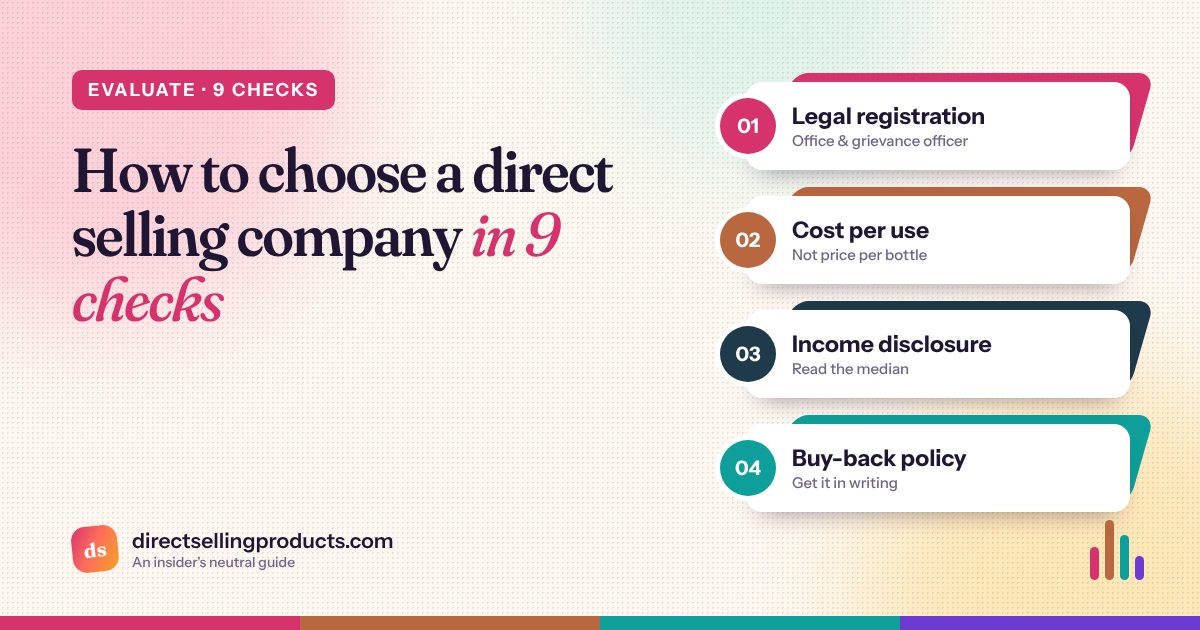
- Confirm it is legally registered where you live
- Test the product without the opportunity
- Work out the cost per use
- Read the income disclosure statement
- Find out where commissions come from
- Price the real start-up and monthly cost
- Read the buy-back and cooling-off policy
- Check product compliance on the label
- Interview the team, not just the company
1. Confirm it is legally registered where you live
Direct selling law is national, so the check depends on where you are:
- India: the Consumer Protection (Direct Selling) Rules, 2021 require a registered entity with a physical office, a grievance redressal mechanism and a named grievance officer. Look for these on the company website, not in a team's WhatsApp group.
- USA: there is no federal licence, but the FTC's guidance sets the line between lawful multi-level marketing and pyramid schemes. Check for state attorney-general actions.
- Malaysia: companies need a licence under the Direct Sales and Anti-Pyramid Scheme Act 1993.
See India, USA and other countries for local detail.
2. Test the product without the opportunity
Imagine the product sitting on a supermarket shelf next to its competitors, with no business plan attached. Would you or your neighbour buy it at that price? If the only reason to buy is to "qualify", the product is a ticket, not a product.
3. Work out the cost per use
Direct selling prices often look high because the pack is concentrated or large. Divide the price by the number of uses before comparing with a shop brand.
| Product | Pack price | Uses per pack | Cost per use |
|---|---|---|---|
| Direct-sold dish-wash concentrate | ₹450 | 150 | ₹3.00 |
| Supermarket dish-wash liquid | ₹199 | 50 | ₹3.98 |
Cost per use, not price per pack
The cheaper bottle costs more each time you use it. Illustrative numbers from the table above.
Use the dilution on the label, not the one in the presentation. How MRP, DP and PV work →
4. Read the income disclosure statement
An income disclosure shows what share of participants earned anything, and typical earnings at each rank. It is the single most honest document a company publishes. If nobody can show you one, treat every income claim you hear as unverified.
When you read one, look at the median earnings, not the average. A few top earners pull the average up a long way. Step-by-step: how to read one →
5. Find out where commissions come from
This is the legal heart of it. Money that comes from products bought by real customers is direct selling. Money that comes mainly from new people joining is a pyramid.
| Question | Legitimate direct selling | Pyramid scheme |
|---|---|---|
| Main source of income | Product sales to customers | Joining fees and recruitment |
| Joining cost | Low or none; kit optional | High, often non-refundable |
| Unsold stock | Written buy-back policy | Your problem |
| Pitch focus | Product, customers, service | Ranks, lifestyle, "get in early" |
| Could it survive with zero recruiting? | Yes, on retail alone | No |
Where does the money come from?
Same three boxes, very different first box. That first box is what regulators look at.
- Direct selling
- Pyramid scheme
Full comparison with legal tests →
6. Price the real start-up and monthly cost
Add up everything you'd spend in the first six months: kit, any monthly purchase needed to stay "active", training events, travel, samples and phone data. Then ask how many retail customers you'd need just to break even.
- Starter kit, and whether it's optional
- Monthly minimum points (PV/BV) to earn commission
- Paid events, seminars and "leadership" tickets
- Delivery charges for you and your customers
7. Read the buy-back and cooling-off policy
A good company will take back unsold, saleable stock for a refund within a set period, and give you a cooling-off window after joining. In India this is part of the 2021 rules. Get the policy as a link or PDF from the company, not as a verbal promise from a team leader.
8. Check product compliance on the label
Regulators differ, but a label tells you a lot in thirty seconds:
- India: food supplements should show an FSSAI licence number. Cosmetics should list the manufacturer's licence details and, if imported, the importer.
- USA: supplements carry a "Supplement Facts" panel and the standard FDA disclaimer on any structure-function claim.
- Anywhere: be wary of products that claim to cure diseases. That's a red flag for the company, and a legal risk for you if you repeat it.
9. Interview the team, not just the company
You don't join a company so much as a team. Ask your would-be upline:
- How many active retail customers do you personally have?
- What did you earn in your first year, after costs?
- How often do you expect me to buy stock?
- What happens if I just want to be a customer?
Frequently asked questions
How do I know if a direct selling company is legitimate?
A legitimate direct selling company earns most of its revenue from product sales to real customers, publishes an income disclosure, offers a written buy-back policy for unsold stock, and is registered in your country with a contactable grievance officer. Income based mainly on recruitment is the defining sign of a pyramid scheme.
How much should it cost to join a direct selling company?
Joining should cost little or nothing beyond an optional starter kit of products you would use anyway. In India, the 2021 rules say direct sellers must not be required to pay an entry or registration fee. Be cautious of any plan that requires large stock purchases to qualify for a rank.
What is the most important document to ask for?
The income disclosure statement. It shows what percentage of participants earn anything at all and typical earnings at each rank. If a company can't or won't provide one, treat every income claim you hear as unverified.
Sources
- Department of Consumer Affairs, Government of India: Consumer Protection (Direct Selling) Rules, 2021. consumeraffairs.nic.in
- U.S. Federal Trade Commission: Business Guidance Concerning Multi-Level Marketing. ftc.gov
- U.S. FTC Consumer Advice: Multi-Level Marketing Businesses and Pyramid Schemes. consumer.ftc.gov
- Food Safety and Standards Authority of India. fssai.gov.in