Key takeaways
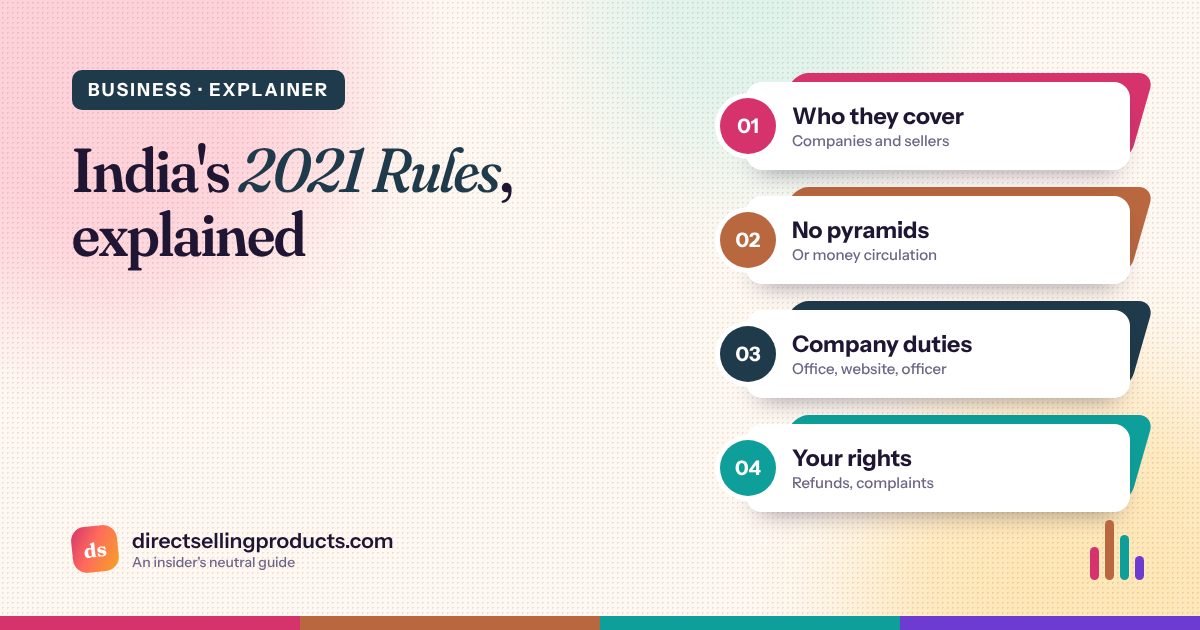
- The rules cover direct selling companies and sellers, and protect consumers.
- They prohibit pyramid and money circulation schemes and misleading claims.
- Companies must be reachable: office, grievance officer, published information.
- Treat this as a plain-English summary. Check the official text for exact wording.
What are India's Direct Selling Rules, 2021?
India's Consumer Protection (Direct Selling) Rules, 2021 are rules made under the Consumer Protection Act, 2019 that regulate direct selling companies and sellers. They prohibit pyramid and money circulation schemes, require companies to be reachable through a registered office and grievance officer, and give consumers refund and complaint rights.
This is a summary in plain English, not the legal text. Confirm exact wording and any updates on the Department of Consumer Affairs site.
The rules at a glance
| Topic | What it means for you | How to check |
|---|---|---|
| Who they cover | Direct selling entities (companies) and direct sellers | Does the company sell through independent sellers? |
| No pyramid or money circulation | Companies mustn't run or promote schemes that pay mainly for enrolling members | Pyramid tests |
| Reachable company | A registered office in India and a grievance officer | Website footer, invoices |
| Information disclosure | Key company, product and plan information should be available to sellers and consumers | Website, written terms |
| Seller contract and fees | No compulsory entry or registration fee; clear written terms | The seller agreement |
| Refunds and buy-back | A route to return goods and get a refund within stated limits | Buy-back policy |
| Fair conduct | No misleading product or income claims by company or seller | Compare team claims with the income disclosure |
| Enforcement | Consumer authorities can act on breaches under the Consumer Protection Act | National Consumer Helpline, state authorities |
What a company should do
- Be a real, reachable entity with a registered office in India.
- Name a grievance officer and respond to complaints.
- Publish key information about itself, its products and its plan.
- Avoid pyramid structures and money circulation schemes.
- Handle refunds according to a clear policy.
What sellers should do
- Describe products truthfully and only as the company's official material does.
- Don't promise income. Don't show earnings you can't back with the company's own figures.
- Respect refunds. Tell customers how to return a product.
- Keep records of sales and communications.
What customers and sellers can expect
- Clear terms before paying, in writing.
- A way to return goods within the stated period.
- A named person to complain to inside the company.
- An outside route if that fails: National Consumer Helpline (1915), then consumer authorities.
Using the rules as a checklist
Take the eight rows above and ask the company for evidence of each. A company that can show you its registered office, grievance officer, plan, refund policy and income disclosure is behaving as the rules intend. One that can't is worth a second look. Use the five-minute legal check and the red flags checklist together.
For a wider view, see direct selling in India and laws by country.
Frequently asked questions
When did India's direct selling rules come into force?
The Consumer Protection (Direct Selling) Rules, 2021 were notified under the Consumer Protection Act, 2019 in late December 2021. Check the official notification for the exact dates and any later changes.
Do the rules apply to individual sellers or only to companies?
They apply to both. They set duties for direct selling entities and rules of conduct for direct sellers, and they give consumers rights.
Where do I complain if a direct selling company breaks the rules?
Start with the company's grievance officer, then the National Consumer Helpline (1915) or your state consumer authority. The Central Consumer Protection Authority can act on wider consumer harm. Keep records of every communication.
Sources
- Department of Consumer Affairs, India: Consumer Protection (Direct Selling) Rules, 2021. consumeraffairs.nic.in
- National Consumer Helpline, India. consumerhelpline.gov.in
- Ministry of Corporate Affairs, India: company master data search. www.mca.gov.in